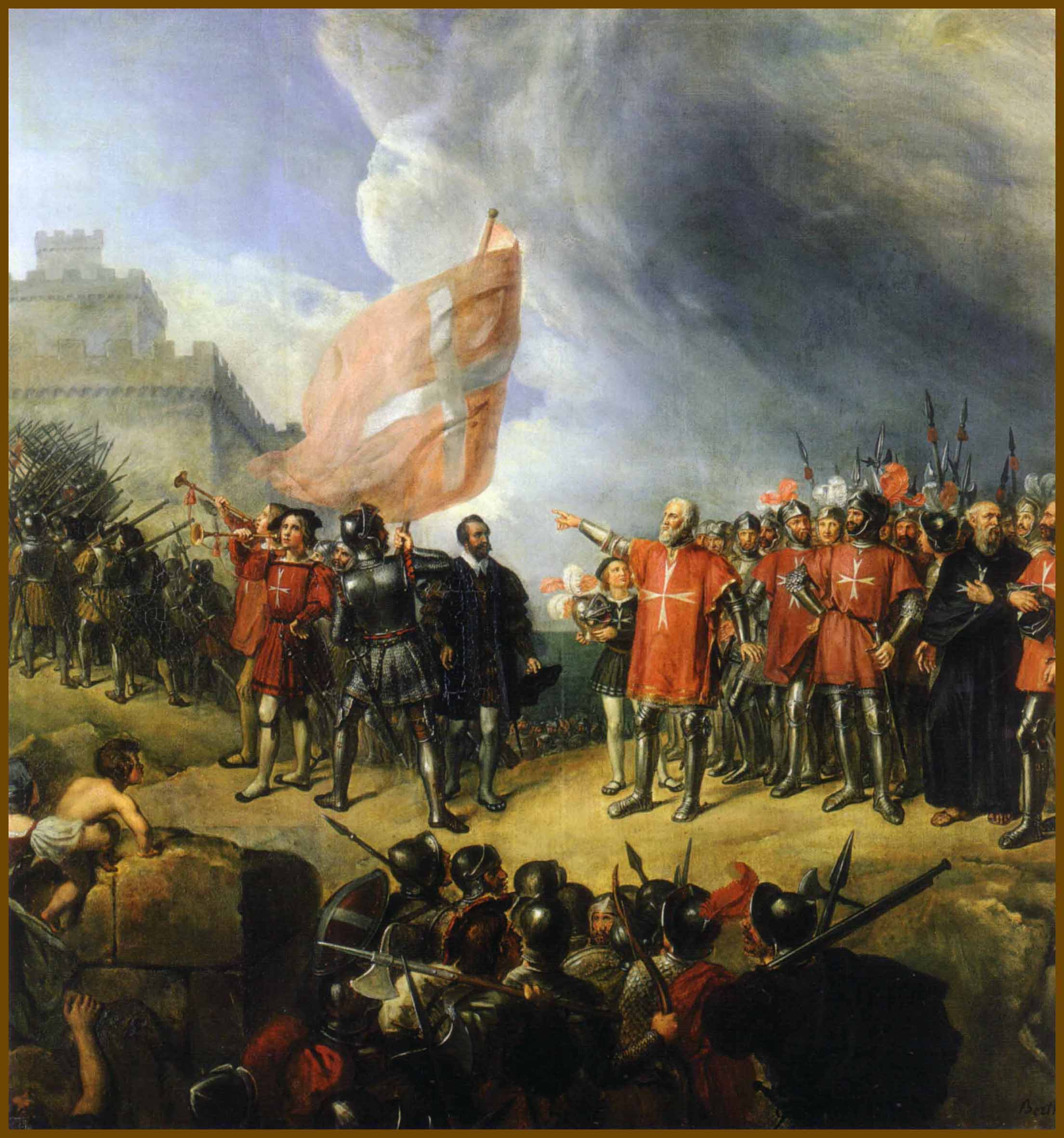
After being ruled for many hundreds of years by the Viceroy of Sicily as part of the Spanish Empire, the Maltese islands were donated to the Order of St John by Charles I of Spain (who was also Emperor Charles V of the Holy Roman Empire). Charles decided to give the Knights of St John a home after they had lost Rhodes in 1522 to the Ottoman Turks of Sultan Suleiman the Magnificent. Malta still belonged to Spain but the Knights could rule over it as if it were nearly their own sovereign territory.
After taking some time to decide, the Order finally accepted Charles’ offer even though Malta and Gozo were quite poor and desolate. Grand Master L’Isle Adam led his Order to Malta and they arrived in 1530.
The Grand Master went to Mdina on 13 November 1530 and took the oath to observe the privileges and usages which had been granted by the King of Aragon more than a century before. At Mdina, being the capital city, the Order took possession of Malta where L’Isle Adam was given the silver key to the city by the Captain of the Rod (Capitano della verga). The Knights did not, however, make Mdina their headquarters and they instead settled in Birgu, near the Grand Harbour where their fleet was anchored.
On 11 January 1693 a strong earthquake hit Malta. Though no one died, many buildings were damaged and among the most severely hit there was the city of Mdina. Many buildings crumbled and one of these was the thirteenth century cathedral. It was soon rebuilt between 1697 and 1703.
In 1730 Grand Master Vilhena decided to build a Magisterial Palace in Mdina. It was built on the site where the Town Hall had stood. This was the place from where the local government or Universitas had directed the city and which had been built around 1454. Vilhena also beautified Mdina and brought it into the baroque age. The design was left in the able hands of Charles de Mondion.
Clothing
Similar to other European countries, people in Malta followed the fashion of the time. Malta was quite akin to the styles and colours in vogue on the continent. In the eighteenth century, for example, women kept a narrow, inverted conical torso above the full skirts. Hoop skirts were worn. They put on low-necked gowns worn over a petticoat. Gowns were usually open in front showing a decorative stomacher.
Men wore coats, waistcoats and breeches. The skirts of the coat was of a narrower style than that used in previous periods. The waistcoats extended to mid-thigh but gradually began to be shortened. Waistcoats could be sleeved or sleeveless.
Maltese women also used a type of headdress which was called għonnella while a more modest version was called the ċulqana. This piece of clothing was made of cotton or silk and was worn by women of different social classes. The most common colour was black but other dark colours were also used. For the wealthier and noble women, bright colours, including white, were adopted.
Peasant dress was simple and practical. Men wore a white shirt and a dark coloured waistcoat and put on a headgear called a milsa. Women used simple, dark coloured, long dresses.
Food
The Maltese had one staple food – bread. This food item was made from grain or from a mixture of different cereals. Ovens for baking bread were spread in the various villages of the island. Other flour food products were the pastizzi, pieces of dough fried in oil, qassatat, macaroni, and vermicelli, along with a wide variety of other pasta types. A new food item was rice which was not favoured by the wealthier classes and was more a food for emergencies than a common plate.
Wine was a main food item which was only second in importance to bread. It was not only men who drank large quantities of wine. Women, did not keep back from their share of this alcoholic drink even if in smaller amounts. Besides wine, brandy (acquavita) was also consumed.
Fish and meat also appeared on the tables. Fish was served in various ways, one of which was aljotta or fish broth. Anchovies and salted fish were eaten by the poorer classes. A wide range of meats were available for those who could afford them, and this included types of poultry. Rabbits were prepared especially in the form of a pie.
New drinking products included coffee, tea and chocolate. All of these became available with the discovery of new lands and the expansion of trade with other, more distant, regions.
Daily Life
Life in the Maltese islands was regulated by the seasons, especially agriculture which followed a strict routine. Rural life was hard and generally monotonous. It was however usually broken by threats of corsair attacks which sometimes turned out to be real incursions by Muslim raisers. Many locals were carried into slavery or lost family and property.
Town life was much different in that it was much more active and varied. Valletta was a cosmopolitan city while Mdina was quiet and secluded. The nobles of Malta lived in the silent city while the knights and the wealthier businessmen lived in Valletta. There was a clear divide between the old Maltese nobility and the Order of St John.
Fashion and food in the cities was quite akin to European standards and practices. People went about their business in the streets of Valletta, stopping to speak to friends and acquaintances and doing all that was done in cities. Slaves also roamed the streets of the capital going about on errands for their masters.
Witchcraft and other superstitions were widespread and the Inquisition had a busy time trying to control and punish transgressors reported by neighbours and law-abiding and righteous persons. Punishments meted consisted of prayer and other acts of repentance as atonement for the sins committed. Drastic sentences such as years of rowing on the galleys, and the more extreme burning at the stake, were much less frequent.