Academia
•
OsteoMag-3D: bone implants that disappear when the body heals
Imagine breaking a bone so severely that a piece is missing. Or imagine recovering from bone cancer, only to be left with a gap your body cannot heal on its own. Today, patients in these situations often rely on metal implants that stay in the body forever or require a second surgery to remove.
OsteoMag-3D is an international partnership that brings together Maltese and Chinese researchers with one shared goal: to create patient-specific bone implants made from a biodegradable magnesium alloy. These implants, often called scaffolds, act as temporary bone substitutes in situations where patients are left with missing bone, such as after bone cancer treatment or when fractures fail to heal. They support new bone growth and gradually dissolve as healing progresses. Over time, they are replaced entirely by natural bone, eliminating the need for a second surgery to remove the implant.
To ensure each patient gets the right fit, OsteoMag-3D uses advanced 3D-printing technology (Figure 1) to customise the implants. This is not the type of 3D printer found at home. Instead, it relies on a high-precision method called Laser Powder Bed Fusion, where a focused laser beam melts extremely fine magnesium powder layer by layer to form a tailored implant with excellent accuracy.
The project brings together four main institutions. From Malta, the University of Malta leads the initiative under Prof. Inġ. Joseph Buhagiar, working closely with consultant orthopaedic surgeon Mr Ryan Giordmaina from Mater Dei Hospital. Their Chinese partners are Southeast University, led by Prof. Jing Bai, and Jiangxi University of Science and Technology under Prof. Youwen Yang. This collaboration combines expertise in materials engineering, mechanical engineering, medical science, and clinical practice.
Magnesium is an exciting material for scaffolds. It behaves similarly to natural bone, is biocompatible, and even releases by-products that can encourage healing. But magnesium also has its issues. Placed inside the body, it can degrade too quickly, vanishing before the bone has fully healed. Its breakdown also produces hydrogen gas, which can create unwanted pockets around the implant. OsteoMag-3D researchers are developing new surface coatings to slow and control this process.
Although the technology is highly promising, it remains in the research stage, and the OsteoMag-3D implant is not yet available on the market. Before any patient can receive such an implant, it must undergo rigorous laboratory testing, clinical trials, and regulatory approval. This process is long and expensive; but essential. Close collaboration between engineers and orthopaedic surgeons ensures that the technology will be safe, effective, and suitable for future clinical use.
The OsteoMag-3D project represents a promising step forward in orthopaedics, with the potential to greatly improve the quality of life for patients who require a bone substitute due to injury or disease. The project receives funding from the Ministry of Science and Technology of the People’s Republic of China (2025YFE0110100) and Xjenza Malta through SINO-MALTA-2024-11 (Science and Technology Cooperation).
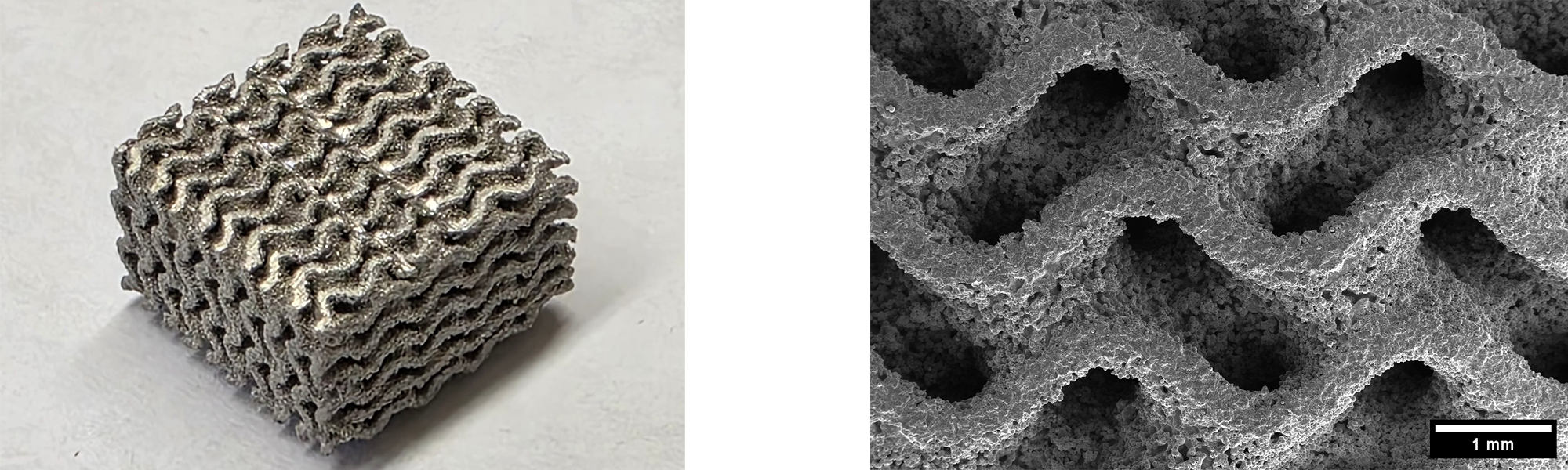
Figure 1: 3D-printed magnesium scaffold implant. (left) A block-shaped sample (10×10×5 mm), and (right) a scanning electron microscope image showing that the printing process successfully produced pores that are about 0.5 mm in diameter. With this type of 3D-printing technology, both the overall shape of the implant and its internal architecture can be customised to meet different medical needs.
Watch our interview with the team who worked on this project: