Learn
•
DISTRICT project concludes with findings on integrated port and offshore power systems
The consortium led by Prof. Alexander Micallef of the University of Malta and Prof. Zhaoxia Xiao of Tiangong University has concluded the DISTRICT project, a two-year Malta–China research collaboration examining how port microgrids and offshore renewable-energy platforms can be jointly designed to reduce emissions from maritime activities.
Funded through the 2023 Sino-Malta Science and Technology Cooperation Programme, the project focused on fundamental research into the floating power supply platform, source-load forecasting, capacity and topology planning, optimisation and control of integrated onshore and offshore energy systems for ports. Its primary objective was to address emissions generated by ships while berthed or anchored, a continuing challenge for ports facing land-use constraints, congestion, and tightening environmental requirements.
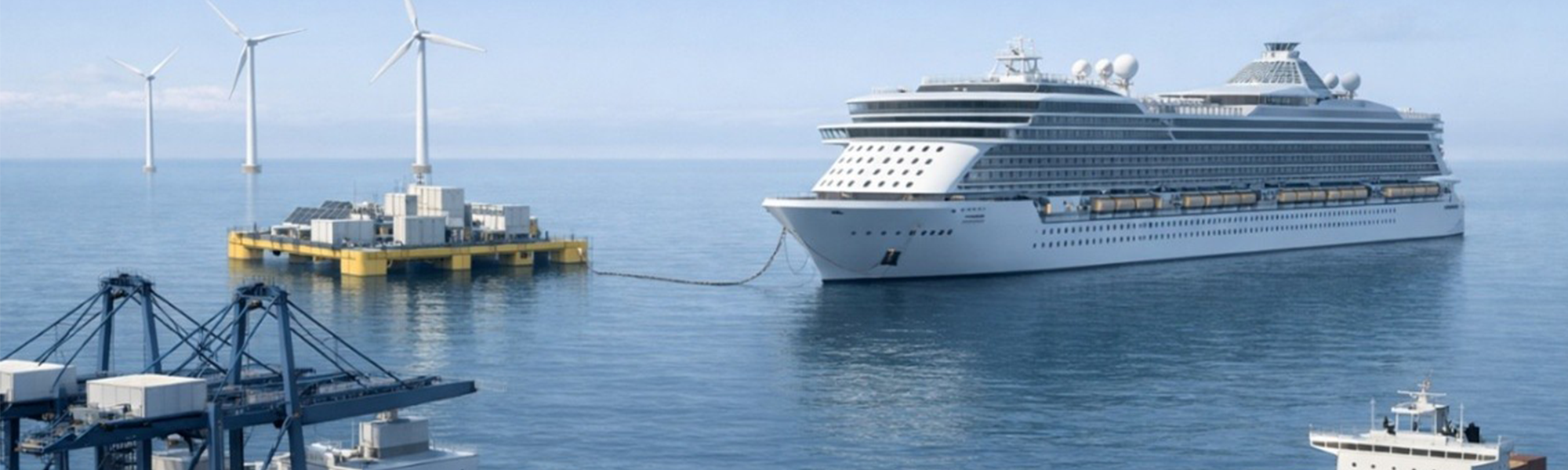
A central research outcome of DISTRICT was the development and simulation of an offshore mooring and power platform supplied by renewable energy and energy storage. The proposed concept allows ships waiting outside ports to shut down onboard diesel generators and draw electrical power from an offshore source. While early studies considered moderate hotel loads, later system-level simulations demonstrated the ability to support multi-megawatt ship demand and multiple simultaneous connections, indicating scalability beyond the original baseline assumptions.
In parallel, the project developed a standardized framework for capacity planning of port microgrids. Using the Port of Valletta and Jiujiang Port as contrasting case studies, the research team combined measured port demand data, renewable resource assessment, and forecasting techniques to evaluate how renewable generation and storage can be sized under realistic operational constraints.
The framework is transferable and can be adapted to ports with differing operational profiles and resource availability.
Another strand of the project addressed control and energy management challenges in converter-dominated port and offshore microgrids. DISTRICT investigated decentralised and hierarchical control architectures, including edge-based energy management strategies. Simulation results showed that stable voltage and frequency regulation can be maintained under variable ship demand and fluctuating renewable generation, while complying with maritime power-quality requirements for shore-to-ship connections.
The outcomes provide a coherent technical foundation for future experimental validation and applied research. The modelling and simulation tools developed under DISTRICT support quantitative assessment of emissions reduction, system resilience, and operational performance, offering ports and policymakers a more robust evidence base for electrification strategies.
Beyond its technical contributions, DISTRICT strengthened long-term collaboration between Maltese and Chinese research teams. The partnership resulted in joint journal publications, conference presentations, and a patent filed in China, reflecting sustained cooperation in system modelling, power electronics, forecasting, and control.
By considering port-side and offshore energy systems as an integrated whole, DISTRICT demonstrates how coordinated design approaches can help overcome spatial and infrastructural limitations faced by many ports. The project contributes to broader international discussions on how ports can transition toward lower-emission operations while maintaining reliability and operational flexibility in an increasingly electrified maritime sector.


