Learn
•
STRADA Project: How AI is ushering Radio Astronomy into a new era
Radio telescopes listen to the Universe day and night. They don’t take pictures the way your phone does; they measure faint, noisy signals and turn them into maps of the sky, filled with jets, lobes, arcs, and the ghostly outlines of galaxies shaping the cosmos over billions of years.
The challenge is scale: modern surveys don’t deliver hundreds of images. They deliver millions. And in that flood of data, some of the most exciting discoveries are hiding in plain sight.
ISSA's Role in Global Astronomy Research
That’s where STRADA comes in: Self-supervised Transformers for Radio Astronomy Discovery Algorithms. Funded by Xjenza Malta under the Research Excellence Programme, STRADA is led by Dr Andrea DeMarco at the Institute of Space Sciences and Astronomy, University of Malta, in collaboration with INAF in Italy. His machine learning team includes Dr Ian Fenech Conti, Ms Hayley Camilleri and Dr Simone Riggi.
Together, they are building a new kind of AI for the radio sky, one that learns first and specialises later.
Building a Foundation Model for the Radio Sky
If the phrase “foundation model'” sounds familiar, it should. In everyday AI, foundation models are the engines behind systems that can write, translate, summarise, and reason because they learn broad patterns first and then adapt fast. STRADA applies that same philosophy to radio astronomy, where labels are expensive, ambiguous, and never quite keep up with the sky.
At the heart of STRADA is STRADAViT, a family of next-generation models based on Vision Transformers (ViTs), a modern architecture that has redefined what’s possible in computer vision. But radio images aren’t holiday photos: they can be sparse, noisy, and shaped by instrument quirks. STRADA starts by standardising how cutouts are presented, so a source from one telescope doesn’t look “alien” to another.
Puzzle Learning
Then comes the part that makes STRADA different: the model learns without being spoon-fed labels. In self-supervised learning, the data becomes its own teacher. STRADA leans on two complementary ideas. One is visual puzzle-solving: hide pieces of an image and train the model to reconstruct what’s missing, so it learns the structure of radio sources rather than memorising labels. The other is compare-and-contrast learning: show the model two different “looks'” at the same source (a positive pair) and teach it to keep them close in its internal representation, while pushing away other sources in the batch (the negatives). “It’s like teaching the model the language of the radio sky before giving it any homework,'' Dr DeMarco says.
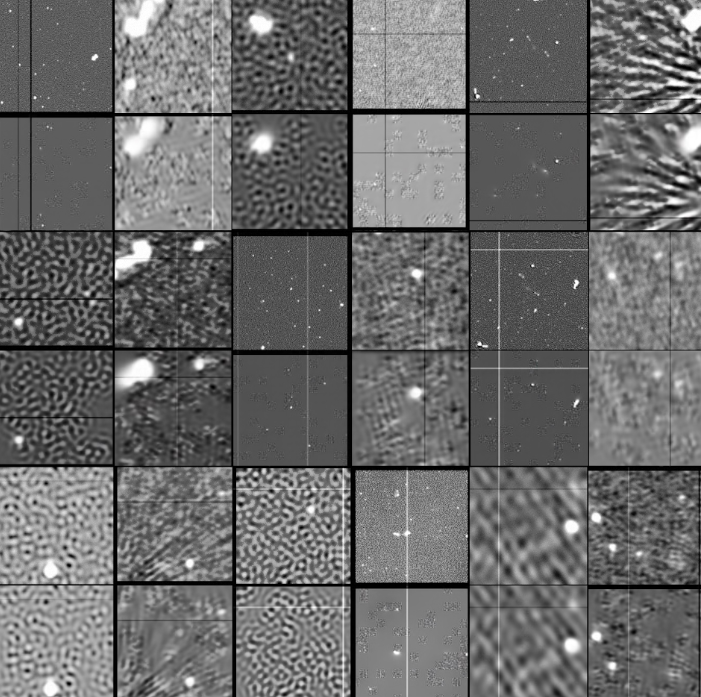
Why bother with this extra sophistication? Because it attacks the biggest bottleneck in modern radio astronomy: turning data into decisions. Downstream tasks are everywhere: morphology classification, artefact filtering, anomaly hunting, candidate triage for follow-up observations. And they arrive across many surveys, not just one. “We’re not trying to build a model that’s good at a single benchmark,” Dr DeMarco says. “We’re trying to build a model that can walk into a new survey and still know what it’s looking at.
This is not “AI replacing astronomers.” It’s AI giving astronomers superpowers. The sky isn’t getting simpler; it’s getting richer. As radio observatories scale up, discovery will increasingly depend on tools that can generalise across surveys, handle messy real-world data, and surface the unexpected, fast.
Identity Under Pressure
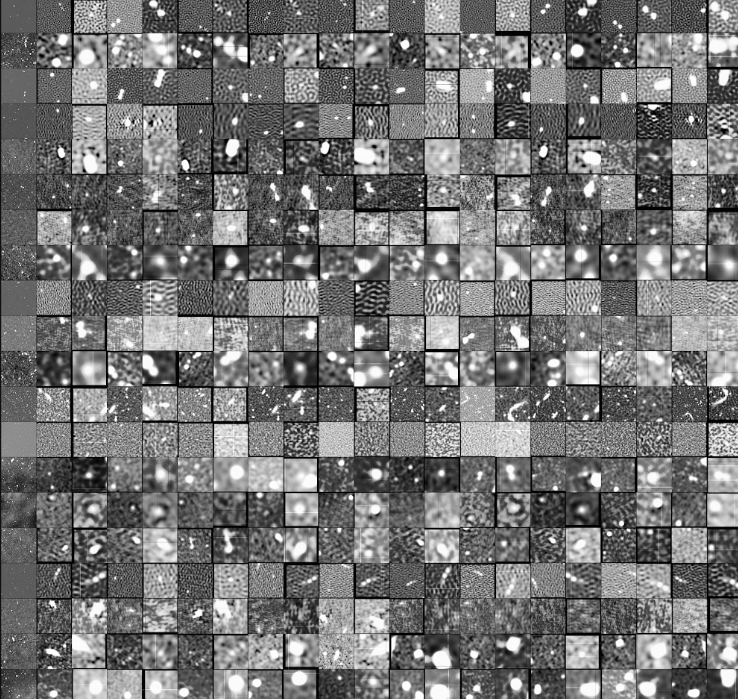
STRADA is also an engineering story. It’s not just about a neural network; it’s about the practical pipeline that makes the model usable and about turning those learning ideas into a tool that researchers can deploy. The rule behind the positive/negative training is clean and powerful: bring true matches closer together in representation space, while keeping different sources distinct. It’s a way to make the model learn identity without ever being handed a label file.
“We’re basically teaching the model identity under pressure,'” Dr DeMarco says. “If two views really belong to the same object, the model must recognise them as the same, even when the presentation changes. And if they’re different objects, the model must keep them distinct.'” Over millions of rounds, the model builds a compact “fingerprint'” for radio morphology: stable when it should be, different when it must.
Not all rivals are equal. Some negatives are obviously different; others are near twins: sources with similar shapes, similar jets, similar arcs. Those hard cases are where the model is forced to pay attention to the details that matter for science. “The hardest examples are the ones that teach you the most,” Dr DeMarco says. “That’s true for people, and it’s true for AI models.”
The bigger picture is clear. Radio astronomy is entering the era of the Square Kilometre Array and other next-generation observatories, where the data volume will be staggering and rare phenomena may be the most valuable. STRADA’s vision is to bring the best of modern AI to that frontier. From the University of Malta, the team wants to help researchers focus on interpretation instead of manual triage.
If the last decade of AI was about teaching machines to see the everyday world, the next decade can be about teaching them to see the Universe.
Latest articles

Meet the People Bringing Science to the City 2026
Learn · 18 Sep 2026


