Academia
•
AIRAS Project launches tool to analyse gender representation in news articles
A University of Malta research project has released a publicly accessible tool that allows anyone to analyse gender representation and sentiment in a news article of their choice, making visible the patterns that are rarely apparent from reading individual stories.
The Article Gender Analyser, available online, is one of two tools developed under the AIRAS project (AI-Driven Media Representation Analysis for Social Equity). The project, led by Principal Investigator Dr Dylan Seychell and funded by Xjenza Malta under the Research Excellence Programme 2024, used artificial intelligence to analyse over 73,000 Maltese online news articles published between 2023 and 2025.
The findings show that men dominate news coverage across every category, accounting for roughly three-quarters of all individuals mentioned. In politics, men are mentioned more than four times as often as women. In sport, the difference is even more pronounced. Even in categories where representation is relatively more balanced, such as society and culture, men still remain the majority. It is worth noting that these results reflect participation in society as much as reporting itself. Where prominent roles are held predominantly by one gender, such as the office of Prime Minister, this will naturally influence the statistics.

The Article Gender Analyser at ainewsanalysis.org allows users to paste any article and receive an instant analysis
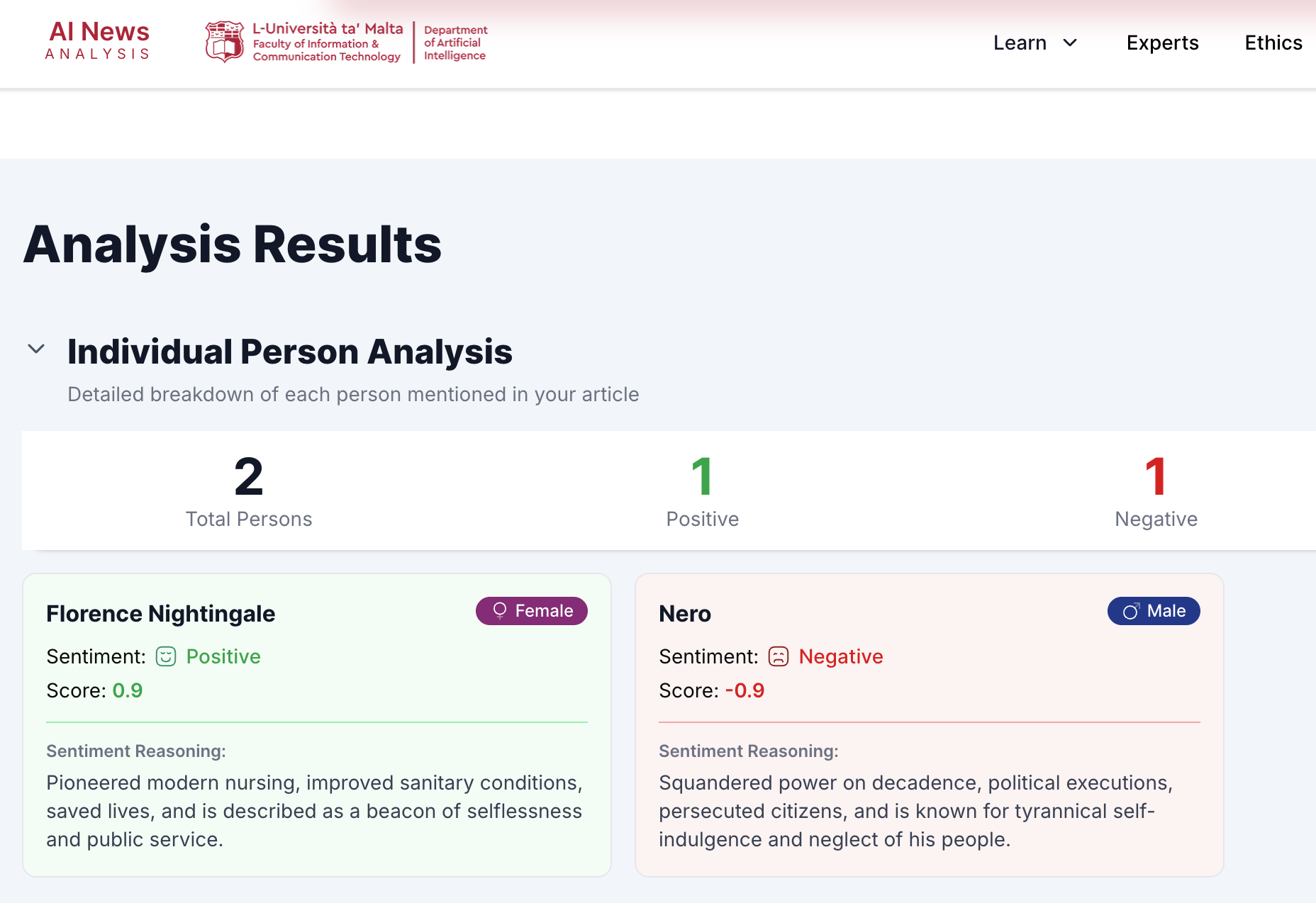
The Article Gender Analyser applies these aggregate findings at the level of a single article. Users paste any article text into the tool, which identifies every named individual, classifies their gender, assigns a sentiment score between -1 (highly negative) and +1 (highly positive), and immediately benchmarks those results against thousands of categorised articles in the database. A reader or author submitting a piece from the Society and Culture category can see at a glance whether that article sits above or below the category norm for female representation, and whether the tone toward each gender diverges from typical patterns in similar coverage.
.png)
Results include per-person sentiment scores and a gender distribution comparison benchmarked against the wider article database
Positive coverage does not necessarily mean fair representation if it is accompanied by limited visibility. How often someone appears matters just as much as how they are described. The tool is designed to make that distinction legible to anyone, not just researchers. The AIRAS project team includes Prof. Matthew Montebello, Prof. Vanessa Camilleri, Prof. Carmen Sammut, and Research Support Officers Joseph Grech, Jonathan Attard, and Olga Sater. The second tool developed under the project is an analytics dashboard that allows users to explore patterns of representation across topics, news outlets, and time.
Both tools are freely accessible online, and anyone interested in participating in these projects is encouraged to contact the project team.
Latest articles


