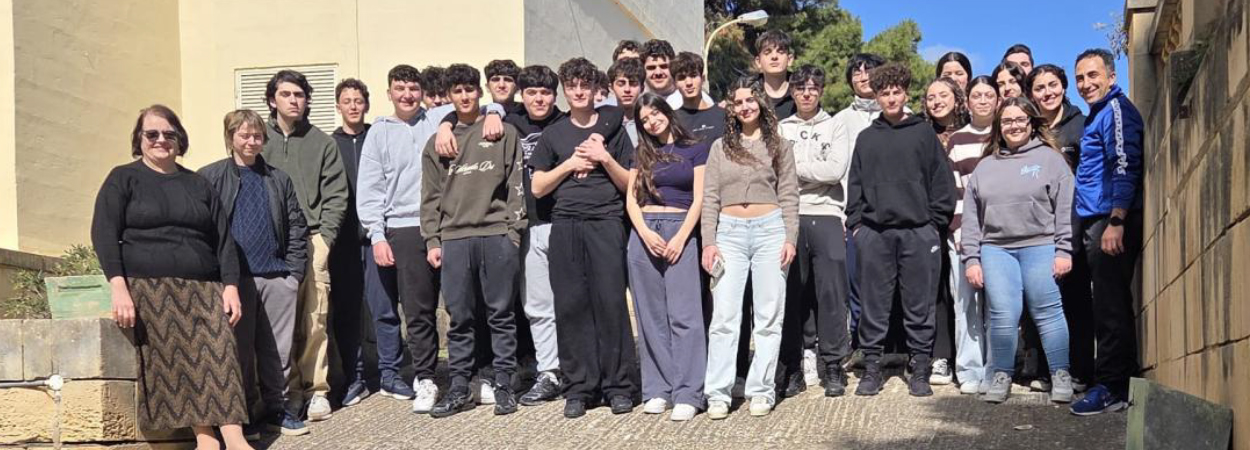
The Physics Department organised the annual Applied Physics Workshop entitled “Beyond the Visible: Applied Physics in Action” at Tas-Silg, Marsaxlokk, from Friday 27th February to Saturday 28 February 2026. Twenty-nine first- and second-year students participated in this engaging two-day event. They were accompanied by the Subject Coordinator, Ms Antonia Vella, and Mr Christopher Busuttil. Mr Kevin Mizzi joined on Saturday evening.
The workshop began with a series of icebreaking activities designed to help students get to know one another and build a positive team spirit for the days ahead. During the icebreaking session, the students were joined by the Principal, Mr Paul Xuereb, who later addressed the students and encouraged them to make the most of the opportunity to explore physics beyond the classroom.
On Friday evening, students participated in a fascinating stargazing session organised by Mr Howard Zammit and the Astronomical Society of Malta. Under the clear night sky at Tas-Silg, they observed celestial objects while learning more about astronomy and the physics behind stellar phenomena. This was followed by an exciting treasure hunt prepared by a past Junior College student Maria Victoria Vella, which combined fun with physics-based challenges.
Saturday morning began with an insightful talk on Seismology and Earthquakes delivered by Mr Alexander Vella. Students explored how seismic waves travel through the Earth and how scientists analyse earthquake data.
The session was followed by a Robotics activity led by Prof. Edward Gatt. He brought along a 20 kg robot built by the Computing Department, which had previously placed third in a robotics international challenge. Students were particularly intrigued by the practical applications of physics principles in programming, mechanics, and automation.
Before lunch, students tested their knowledge in a lively Physics Quiz. After lunch, they engaged in several team-building activities related to core physics principles, encouraging collaboration and problem-solving skills.
Later in the afternoon, Professor Carmel Caruana delivered a highly interesting talk on Medical Imaging. Students had the opportunity to analyse MRI scans using a specialised app on their laptops, gaining insight into the physics behind modern diagnostic techniques.
In the evening, the workshop concluded with a scavenger hunt focused on waves, simple harmonic motion (S.H.M.), and sound. This interactive activity was both educational and enjoyable, providing a dynamic end to an enriching workshop experience.
The Applied Physics Workshop 2026 was a great success, offering students the opportunity to experience physics beyond the classroom — demonstrating clearly how applied physics plays a vital role in understanding the world around us.