People
•
Nurturing the Child’s Imagination: Lessons from a Team-Building Day Professional Development Session at the Childcare Services offered at UM
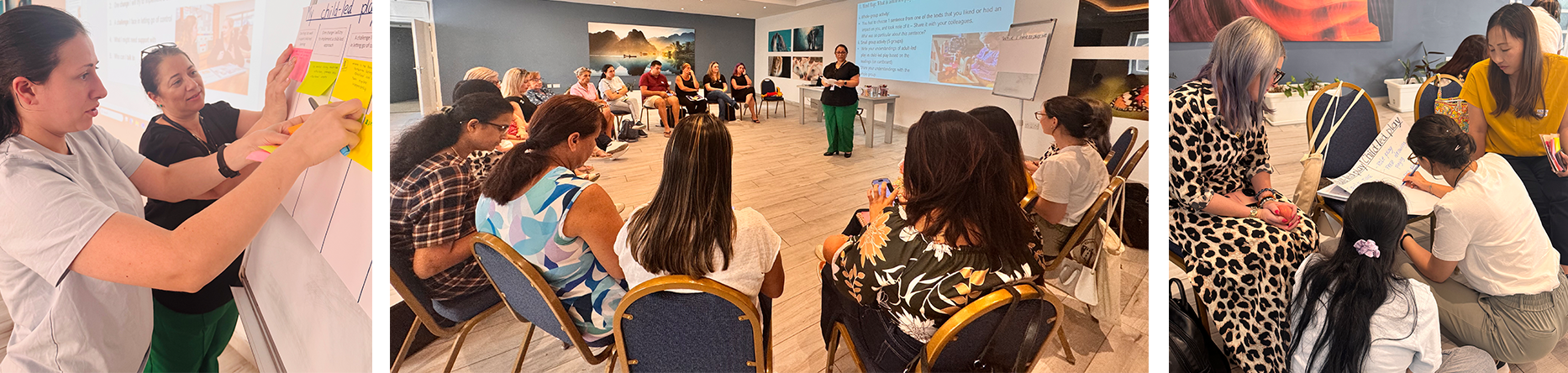
On Friday 19 September, educators from Ilwien Childcare Centre, It-Tajra Childcare Centre, and Il-Perla Kindergarten set aside their daily routines for a team-building day devoted to play and imagination. The training, led by Dr Josephine Deguara, a senior lecturer at the Department of Early Childhood & Primary Education, Faculty of Education, focused on the child-led approach — a method that places children’s questions, discoveries and ideas at the heart of the classroom.
During the session, staff reflected on Helen Buckley’s picture book The Little Boy, which tells of a child whose creativity is gradually stifled by rigid instruction. The story reminded educators how easily children’s natural imagination can be overshadowed by adult expectations. Subsequently, Dr Deguara invited staff to draw a flower. To everyone’s surprise, most drew an identical stereotype image of a flower — a vivid illustration of how routine and conformity can unintentionally limit creativity.
A Shift in the Teacher’s Role
Child-led learning requires educators to observe and guide whilst responding to children’s curiosity and emerging questions. One example shared during the workshop involved a child interested in travel. Using magnetic tiles and blocks, the child began exploring airports, safety fences and holiday planning. The project grew organically, engaging children in real-world learning: creating checklists, packing, planning activities, thinking about seasonal clothing, and figuring out how to get to the airport.
While inspiring, the approach can challenge educators who are more familiar and accustomed to applying adult-led methods. Teachers must balance freedom with structure, ensuring children feel secure and routines are respected, while still allowing space for imagination to flourish.
Protecting the Spark
For the staff employed at the three settings (one located at UM and two located at Junior College), this training was more than professional development. It was a reminder of the responsibility educators carry: to protect children’s creativity from being extinguished and replaced by their performing to meet adult expectations.
Participants reflected that education can sometimes focus more on compliance than discovery. Child-led learning encourages problem-solving, collaboration, and a lasting love of learning based on their interest, but it also requires trust and confidence; from teachers and parents; to accept that meaningful learning should involve children and their participation and contribution directly, even if it may be considered as somewhat messy or unstructured.
Dr Deguara concluded by reminding the staff that “Our role is to explore and discuss ways our teaching styles can be adapted to better support children’s growth and encourage them to engage in exploration and learning.”
More information about the activities conducted by the childcare centre can be found on their Facebook Page.
Latest articles


UM SEA-EU Research Seed Fund 2026 Awardees
People · 5 Aug 2026


