Academia
•
PALEOSIM research selected as highlight paper on climate and ecology
A new study led by University of Malta researcher, Dr James Ciarlo`, has been published in the high-impact journal Earth System Dynamics and selected as a highlight paper for its innovative contribution to biodiversity and climate research. The study also involves the collaboration of University of Malta researchers Dr Monique Borg Inguanez, Prof. Aaron Micallef, and Prof. David Mifsud, as well as Dr Erika Coppola, a researcher from the Abdus Salam International Centre for Theoretical Physics.
The paper – A climate suitability index for species distribution modelling applied to terrestrial arthropods in the Mediterranean region – is a deliverable of the PALEOSIM project, funded by the European Commission’s Marie Skłodowska-Curie Actions Postdoctoral Fellowship (MSCA PF). The project is a collaboration between the University of Malta, the Abdus Salam International Centre for Theoretical Physics (ICTP) in Trieste, and Esplora Interactive Science Centre, with a shared focus on ecosystems, small islands, and high-resolution climate modelling.
The study introduces a novel climate suitability index designed to link species’ observed distributions with their climatic preferences. Using terrestrial Mediterranean arthropods as a test case, the index combines ecological data with regional climate model simulations to map the suitability of habitats. This provides a rapid and reliable way of assessing how sensitive species are to climate change and identifying areas where populations are most at risk. The findings highlight the potential of this method to strengthen conservation strategies by offering insight into species’ resilience and vulnerability to climate change.
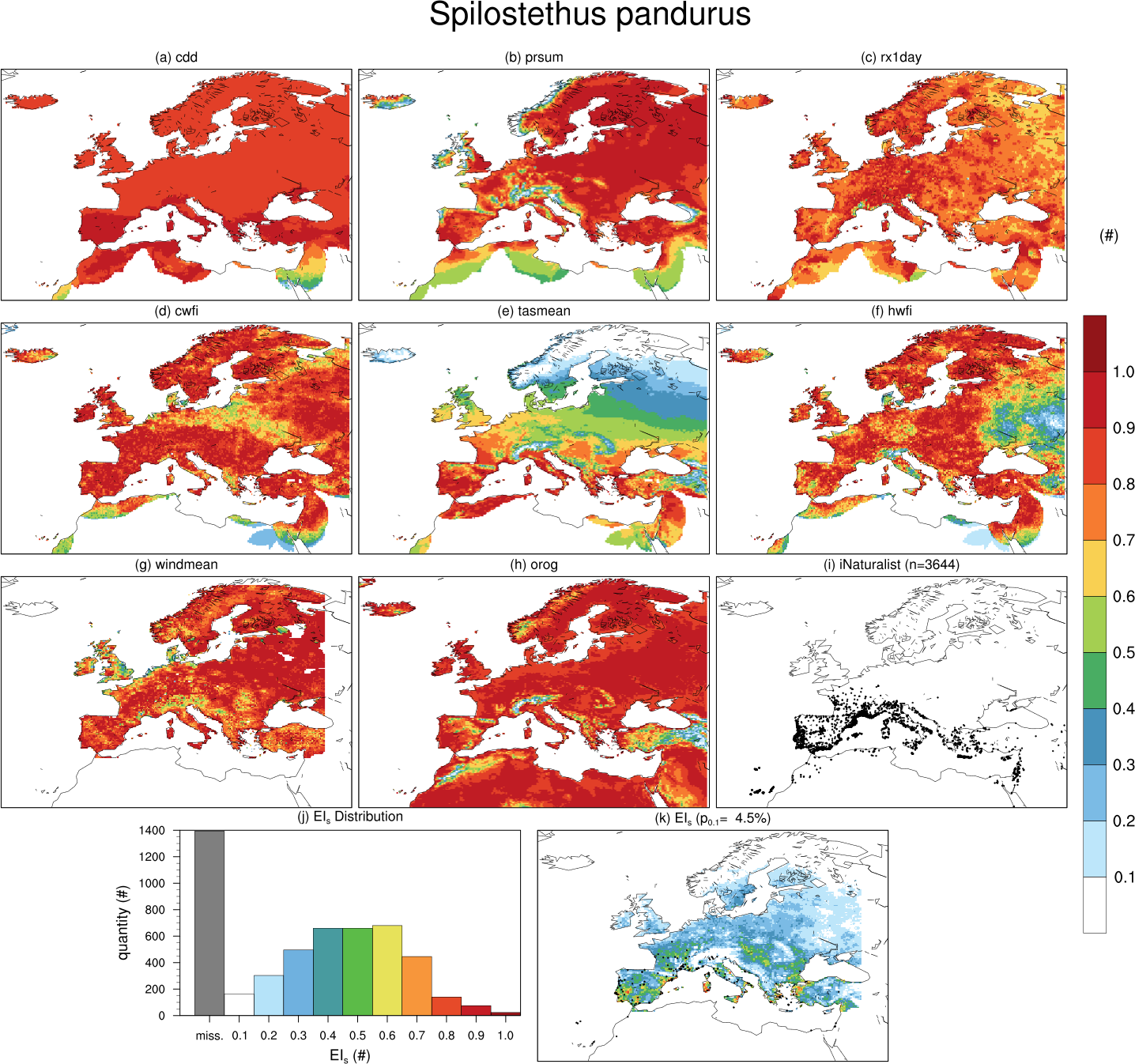
The figure below, taken from the study, illustrates how this climate suitability index is built from climate indices and observational data, providing an example for the seed bug, Spilostethus pandurus. Panels (a) to (h) showcase eight climate indices and where each individual condition is found to be most suitable for this species. Panel (i) shows the distribution of observations for the species. Panel (j) shows the value of the climate suitability index at each observation point. Panel (k) shows the spatial distribution of the climate suitability index. Importantly, the study underlines that these results are intended as a proof of concept, rather than definitive distribution maps, and stresses that any application of the index to a species should be preceded by a statistical evaluation of climate indices to determine the most relevant conditions.
The University of Malta has also produced a short video summary, available below, which explains the study’s methods and broader ecological implications.
This research demonstrates how advanced climate modelling and ecological knowledge can be combined to address urgent questions about biodiversity loss, not only in the Mediterranean but across the globe.
Full citation:
Ciarlo’, J. M., Borg Inguanez, M., Coppola, E., Micallef, A., and Mifsud, D.: A climate suitability index for species distribution modelling applied to terrestrial arthropods in the Mediterranean region, Earth Syst. Dynam., 16, 1391–1407, https://doi.org/10.5194/esd-16-1391-2025, 2025.


