
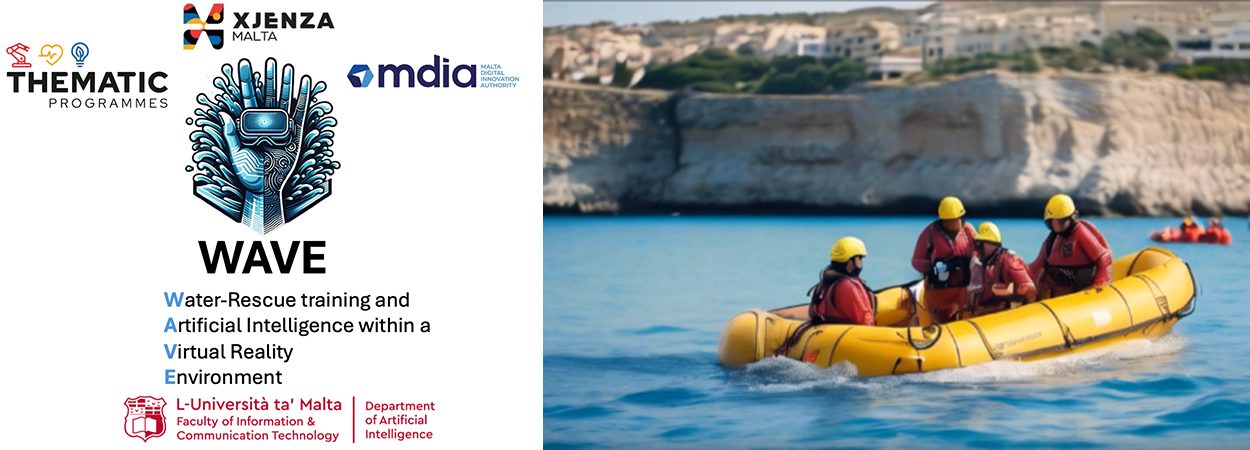
The project WAVE has been launched earlier this year at the AI Department within the Faculty of ICT. This initiative, sponsored by MDIA and Xjenza Malta's Thematic Programmes is a cutting-edge training solution developed to enhance the skills of water-rescue personnel.
By leveraging advancements in Virtual Reality (VR) and Artificial Intelligence (AI), this project aims to provide realistic, immersive training experiences that are crucial in preparing rescuers for the complexities of real-life water emergencies.
The key opportunity identified by this project lies in addressing the existing gaps in traditional water-rescue training methods. Current training programs often lack the variability and intensity of real-world scenarios, limiting the preparedness of rescue personnel. Additionally, there is a need for more targeted and adaptive training methods that can respond to the unique challenges presented by different water-rescue situations.
WAVE, referring to a sea wave and also to the wave gesture of someone in distress at sea, utilises Generative AI (GenAI) to create a diverse array of realistic water-rescue scenarios within a controlled virtual environment. These scenarios range from calm waters to turbulent storm conditions at local key swimming spots around the Malta islands as the incorporation of MultiModal AI (MM-AI) enables the input of multiple data modalities including text for scenario description and images of specific sea or pool locations, thereby tailoring the training environment closely to real-world conditions.
This capability not only brings a higher degree of realism to the simulations but also enables the generative AI to create highly specific rescue scenarios based on the provided data. Student rescuers will be able to experience and adapt to a wide range of potential emergencies enhancing even more the effectiveness of the educational process. Furthermore, the project employs eXplainable AI (XAI) technologies to provide real-time feedback and rationale behind the best courses of action in each scenario. This dual approach not only enhances the training realism but also deepens the understanding of decision-making processes, ultimately improving the efficacy of the training and the subsequent real-life rescue operations.
The project, that is led by Prof. Matthew Montebello, has already registered progress during its first period of execution through simulations of complex rescue operations that are providing transparent, context-specific insights into decision-making. Project WAVE represents a significant step forward in the field of emergency response training as it integrates VR and AI technologies ensuring that rescue personnel are not only well-trained but are also adaptable and prepared for the unpredictable nature of water rescues.


