
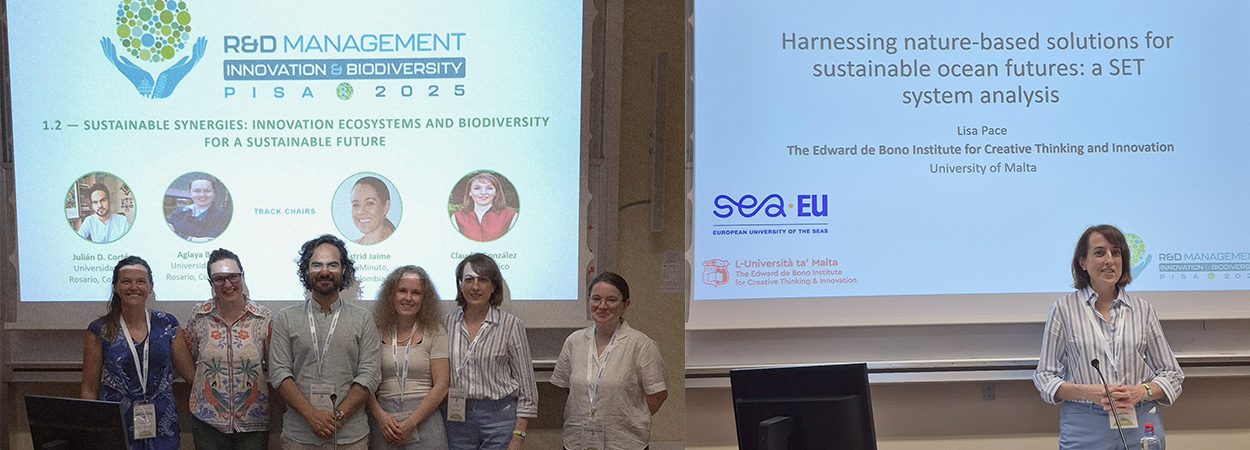
In early July the city of Pisa hosted the international R&D Management Conference, an annual international gathering that brings together researchers, professionals, and policymakers to explore current themes in innovation and research management. This year’s focus on Innovation and Biodiversity reflected a growing recognition that addressing environmental challenges requires rethinking how we define and apply innovation to advance the sustainability and circular agendas.
Dr Lisa Pace from The Edward de Bono Institute for Creative Thinking and Innovation presented her work at the conference on ‘Harnessing nature-based solutions for sustainable ocean futures’. “It is interesting to see management and innovation scholars collaborating with natural scientists on topics as diverse as biodiversity accounting, sustainable value chains and business models”, said Dr Lisa Pace.
The work that Dr Pace presented reflects preliminary findings from the POSEIDON project on ‘Exploring Pathways tOward Sustainable ocEan futures: tensIons, traDe-offs, and just transitiONs’ that aims to explore sustainability futures as strategic courses of action or pathways adopted by various actors to transition from present conditions towards preferred future visions or clearly defined objectives.
“We often think of sustainability as a desirable end goal; but there are also unintended outcomes from scaling sustainability initiatives that needed to be considered”, Dr Pace said. “As the research from the POSEIDON project progresses, we hope to offer insights that can inform both academic debates and practical approaches to sustainable development in coastal areas”.
One of the most striking takeaways from the conference was how deeply the future of biodiversity is linked to questions of equity, access, and long-term planning. Moving ‘beyond green’ means thinking not only about environmental protection but also about how innovation can support fair and lasting transitions for communities and natural ecosystems alike. Nowhere is this more urgent than in our oceans, which are facing mounting pressures from climate change, pollution, and overuse.
The POSEIDON project is supported by the University of Malta’s SEA-EU Research Seed Fund programme and is a collaborative initiative with the University of Algarve.


