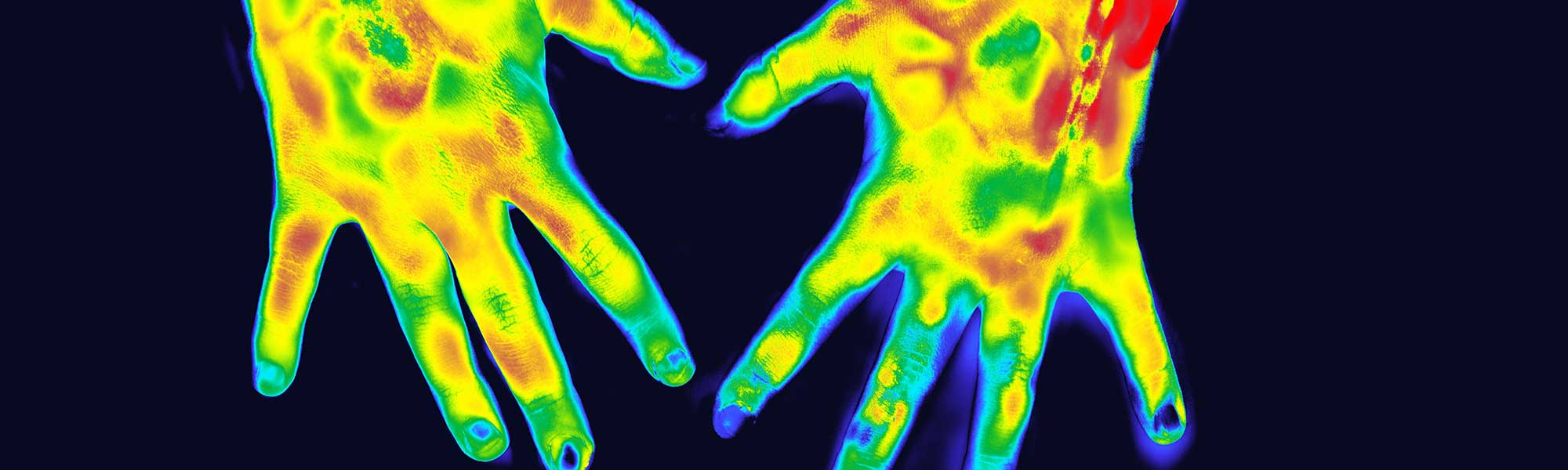
Thermal imaging or Infrared thermography are modes of image acquisition which capture the infrared radiation emitted by any object with a temperature above 0 kelvin. Thermal images thus give information about the skin surface temperature of the object being monitored. This research aims to study the effects of pathologies or conditions of interest on the skin surface temperature in humans. One area being studied is the effects of diabetes and peripheral arterial disease on the thermal signatures of patients' limbs. Using state-of-the-art thermal cameras, the thermal patterns emitted at the cutaneous level as infra-red radiation are picked up and studied and the suitability of such devices to monitor these conditions is evaluated.
Another research utilises thermographic techniques to study the sub-cutaneous thermal signature of amniotic fluid within a mother's womb. The aim is to assess the possibility of using thermal cameras to quantify the amount of amniotic fluid present, as the latter measure is used by clinicians to gauge the baby's health.
Below is a list of the publications in the field of medical thermal imaging authored by researchers within the Center for Biomedical Cybernetics:
A. Gatt, C. Formosa, K. Cassar, K.P. Camilleri, C. De Raffaele, A. Mizzi, C. Azzopardi, S. Mizzi, O. Falzon, S. Cristina, N. Chockalingam, 'Thermographic Patterns of the Upper and Lower Limbs: Baseline Data,' International Journal of Vascular Medicine, vol. 2015, 9 pages, 2015.
A. Ciantar, O. Falzon, L. Sammut, M. Schembri, Y. Muscat Baron, J. Calleja-Agius, P. Demicoli and K.P. Camilleri, 'Registration of dynamic thermography data of the abdomen of pregnant and non-pregnant women.' In Engineering in Medicine and Biology Society (EMBC), 2018 Annual International Conference of the IEEE, pp. 5668-5671. IEEE, 2018.
O. Falzon, A. Ciantar, L. Sammut, M. Schembri, Y. Muscat Baron, J. Calleja-Agius, P. Demicoli and K.P. Camilleri, 'Principal component analysis of dynamic thermography data from pregnant and non-pregnant women.' In Engineering in Medicine and Biology Society (EMBC), 2018 Annual International Conference of the IEEE, pp. 5664-5667. IEEE, 2018.
L. Cutajar, O. Falzon, A. Mizzi, I. Swaine, K. Springett, S. Mizzi, 'A novel method to determine dynamic temperature trends applied to in-shoe temperature data during walking.' In Engineering in Medicine and Biology Society (EMBC), 2018 Annual International Conference of the IEEE, pp. 3958-3961. IEEE, 2018.
J. Gauci, O. Falzon, K.P. Camilleri, C. Formosa, A. Gatt, C. Ellul, S. Mizzi, A. Mizzi, K. Cassar, C. Sturegon, and N. Chockalingam, 'Automated Segmenation of Regions of Interest from Thermal Images of Hands', in Proc. of the 39th Annual International Conference of the IEEE Engineering in Medicine and Biology Society (EMBC’17), Jeju, South Korea, Jul. 2017.
A. Casha, O. Falzon, J. Gauci, 'A preliminary Investigation into the use of Thermography during Cardiac Surgery', in Proc. of the 11th Malta Medical School Conference, Malta. Nov. 2015.
M. Muscat, Y. Muscat Baron, R. Muscat Baron, M. Brincat, K.P. Camilleri, C. Azzopardi, S. Cristina, O. Falzon, 'Thermographic studies of the pregnant uterus', presented at the 8th Malta Medical School Conference, Malta, 2012.
M. Muscat, Y. Muscat Baron, R. Muscat Baron, M. Brincat, K.P. Camilleri, C. Azzopardi, S. Cristina, O. Falzon, 'Comparison of thermographic imaging of the pregnant uterus with and without spontaneous rupture of membranes', presented at the 8th Malta Medical School Conference, Malta, 2012.
M. Muscat, Y. Muscat Baron, R. Muscat Baron, M. Brincat, K.P. Camilleri, C. Azzopardi, S. Cristina, O. Falzon, 'Standardization of the methodology in foetal thermography', presented at the 8th Malta Medical School Conference, Malta, 2012.
J. Bigeni, S. Vella, Y. Muscat Baron, C. Azzopardi, K.P. Camilleri, M.J. Cachia, 'Digital thermographic imaging: a novel monitoring approach in charcot neuroarthropahy with potential clinical usefulness', presented at the 8th Malta Medical School Conference, Malta, 2012.