It’s 2024! This is a special year for us. This year we turn 20!We think that a couple of decades of work in environmental education and ESD are well worth celebrating. A lot has happened in this time and we shall be marking this significant milestone by highlighting some of the work and achievements of our Centre over these years.We are thus launching a celebratory campaign that spans the entire year: 20 years, 24 highlights.
Throughout this year we will be highlighting different aspects of our work and story. We invite you to join in this celebration by sharing our achievements and these highlights with your contacts to reach more people who aspire towards a sustainable world that has enough, for all, for ever.
We thank you for your continuous interest in our work and wish you all a fantastic 2024.
Highlight 1- The Master in Education for Sustainable Development (MESD)
The Master in Education for Sustainable Development (MESD) is CEER’s flagship programme and was created in 2012 following an assessment of ESD provision that pointed at the lack of local, structured postgraduate educational programmes in the field of ESD. The course of studies was designed to ensure theoretical and practical competence in the speciality providing the academic underpinning for applicants who may wish to achieve competence as ESD experts. The course structure enables students to study issues related to ESD in practice and ‘in situ’ in different environmental realities, and to experience different environmental, economic, social, cultural, political and educational perspectives. It also equips students with the skills and attitudes necessary to promote sustainable lifestyles in the community.

Highlight 2- Influential role in Teacher Education
Recognizing the significance of educators as catalysts for change, CEER has, over the years played a pivotal role in empowering teachers with the skills and resources to champion ESD by:

Highlight 3- The Certificate in Environmental Interpretation and Education
The Certificate in Environmental Interpretation and Education was launched in October 2022 and aims to present students with different perspectives of Sustainable Development and the interaction between the environment and society - specifically in natural areas. The course highlights different perspectives on environmental management, environmental planning, society and the economy, while at the same time utilising a pedagogical framework of about, through and for the environment. This course has a very strong practical component providing students with first-hand experiences of current and prospective environmental/sustainable development issues. Furthermore, it lays the foundation for people who would like to work within environmental fields and targets NGOs, government employees involved in environmental policies, those aspiring to work within natural parks, green leaders, local councillors, and community workers. The course is also suitable for those who are interested in learning more on the people – environment nexus.

Highlight 4 - Active International Networking.
Networking plays a crucial role in international sustainability education. It allows CEER to connect, collaborate, and share knowledge and resources to address global sustainability challenges. Through networking, educators, researchers, and practitioners can exchange best practices, innovative ideas, and research findings, fostering a collective effort towards sustainable development. Networking in international sustainability education enables the creation of partnerships and collaborations between institutions and individuals from different countries and cultural backgrounds including the European School of Sustainability Science and Research, and the Inter-University Sustainable Development Research Programme, which are mainly focused on producing high quality research at the international level, and Commission on Education and Communication, and International Union for the Conservation of Nature, which are more focused on policymaking and raising awareness.This diversity of perspectives and expertise enhances the quality of education and research, leading to more comprehensive and effective solutions to sustainability issues. Furthermore, networking provides opportunities for capacity building and professional development. By connecting with experts and practitioners in the field, CEER students and staff can access workshops, and conferences that promote knowledge exchange and skill enhancement for example: the C-Map workshops on methodologies in 2023. Networking helps CEER to build a global community of sustainability professionals who can contribute to the implementation of ESD practices worldwide.

Highlight 5 - The Master in Intercultural and Environmental Management of Schools
The Master in Intercultural and Environmental Management of Schools (known as 3EMI), offered in 2009, played a pivotal role in advancing education for sustainable development in Malta. Nineteen students seized the opportunity to delve into ESD at a master's level. This professional program, funded by the European Union, was a collaborative effort between the University Cà Foscari of Venice, CEER, and a consortium of five international partners. 3EMI focused on empowering schools through intercultural eco-management tools that allowed students to apply theoretical frameworks on intercultural dialogue and sustainable development to practical projects, addressing real needs within schools.These intercultural eco-managers demonstrated that sustainable development planning is not just a concept but an achievable reality. They utilized available tools and expertise to transform schools into sustainable institutions. The 3EMI Project exemplified how effective education for sustainable development can be realized through carefully planned and managed programs that adopt a whole school approach.
Highlight 6 – Collaboration with other Higher Education Institutions
CEER stands as a model for collaboration with fellow local and foreign Higher Education institutions in its pursuit of advancing ESD. CEER’s commitment to sustainability knows no bounds, as it actively engages in partnerships with other universities and colleges. This collaboration takes shape through joint research endeavours, student and faculty exchange programs, the sharing of best practices, co-hosting international conferences and workshops, and the creation of collaborative publications and resources. Through these alliances, CEER is not only enriching its own ESD initiatives but also fostering a global network of institutions dedicated to a sustainable future.
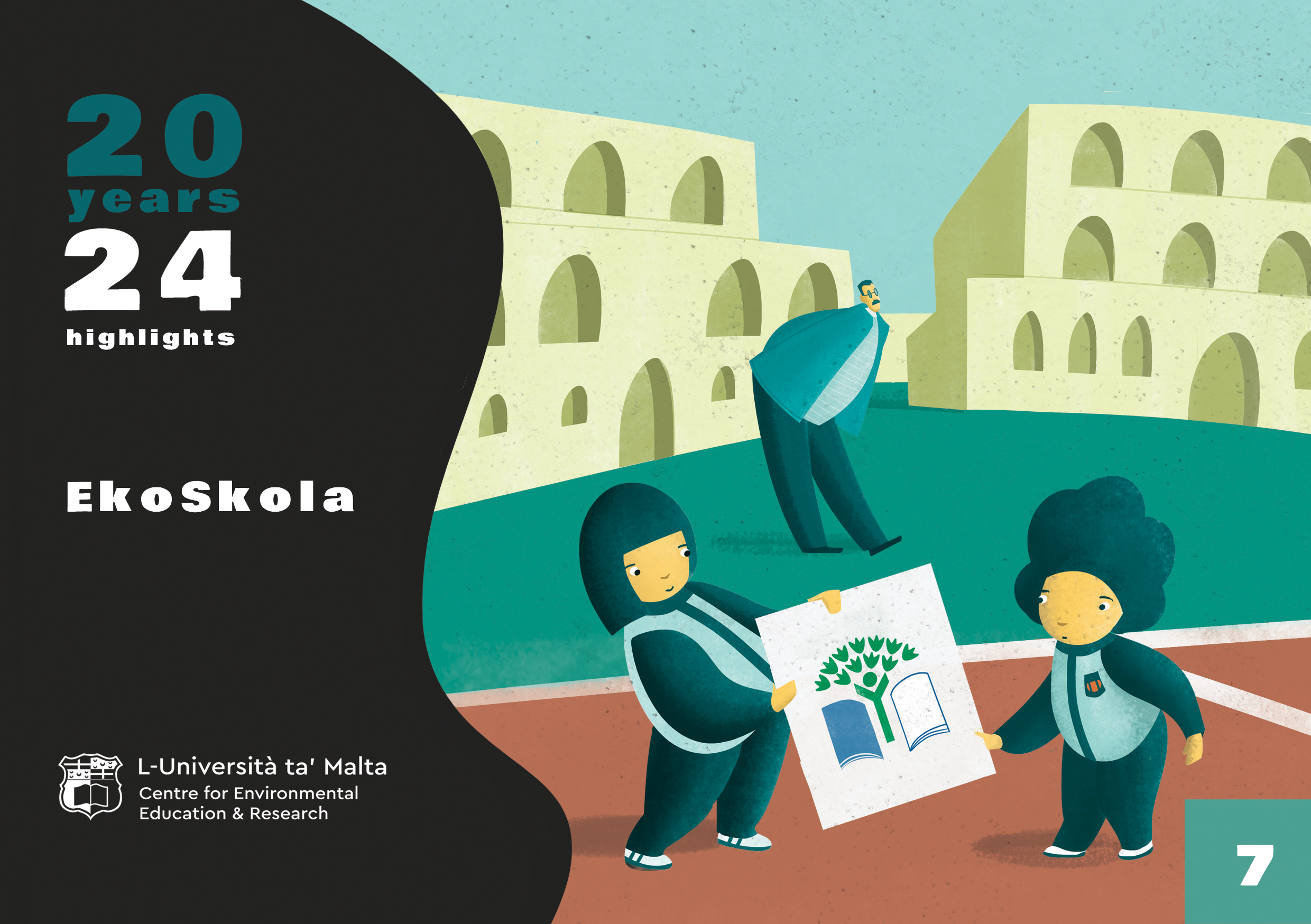
Highlight 7 - EkoSkola
CEER strategy to promote ESD in schools through teacher training and research projects fell short of expectations because of inflexible educational practises. CEER reconsidered its approach and partnered with Nature Trust – FEE Malta, to implement the international Eco-Schools program, locally known as EkoSkola.
Through EkoSkola’s methodology, CEER could work collaboratively with schools to focus on sustainable development themes, promote participatory pedagogies, include sustainable practices in their School Development Plans, and become catalysts for social transformation through community-based ESD initiatives.
EkoSkola quickly became the primary ESD program in Malta, reaching 85% of students across all school levels and sectors, and became synonymous with quality education. Research demonstrated that EkoSkola encouraged personal, institutional, and communal sustainable behaviour, fostering active participation in local and national sustainable development decision-making forums. This positive impact led to the inclusion of ESD as a cross-curricular theme in the National Curriculum Framework, consolidating EkoSkola’s positive influence on education in Malta.

Highlight 8 – Promoting ESD within the University of Malta
CEER champions the idea of Education for Sustainable Development (ESD) as a cross-curricular imperative. At university level, this approach ensures the infusion of sustainability principles throughout various faculties, leveraging CEER's expertise to foster a holistic educational environment. Collaborations of mention are those with the Faculty of Education and the Faculty for Social Wellbeing, where CEER delivers both undergraduate and postgraduate modules. Additionally, CEER's leadership in drawing up a sustainability strategy for the Faculty of Education underscores its fundamental role in promoting sustainability principles across academic sectors. Through these endeavours, CEER reaffirms its commitment to embedding sustainability at the heart of tertiary education.

Highlight 9 – The Fawwara ESD Centre
Located in the picturesque surroundings of Fawwara, Siġġiewi, CEER’s Fawwara ESD Centre is a multipurpose centre for research and practice in Education for Sustainable Development (ESD).
Since ESD can potentially take innumerable guises, the Fawwara ESD Centre has been designed as a flexible and inclusive space that is able to respond effectively to a multitude of different ESD-related

Highlight 10 – Establishing the ESD Practitioners Group
During their MESD journey a group of MESD students, conducted research to look into the need for ESD professionals to acquire formal recognition in the form of a professional warrant, as well as the existence of such warrants in other countries. From this initial work a group of M.ESD students, decided to come together, along with CEER Director Prof. Mark Mifsud, to establish the "Malta Association of Professionals in ESD" (MAPE). Apart from promoting ESD among the general public, the association aims to seek formal recognition for ESD professionals as well as provide a platform for professional growth.
The group is in its final stages of formal registration and will be operating publically soon.
Highlight 11- Peer Reviewed Publications
CEER stands at the forefront of Education for Sustainable Development (ESD) research. Although being composed of a small nucleus of staff, CEER is now moving well towards becoming a recognised Centre of research excellence through enhanced collaboration with international networks, such as the European School of Sustainability Science and Research and the Inter-University Sustainable Development Research Programme, and through increased participation in projects and research of the highest standard.
The Centre has amassed over 4000 citations and 2 of its academic staff are in the top hundred most cited all time/all disciplines researchers at the University of Malta. CEER places fourth out of the present 13 Centres at the University of Malta with more than eighty peer-reviewed publications to its name. CEER staff have also been awarded Best Paper Awards at a number of meetings including the World Symposium of Environmental Education in 2014 and the World Symposium on Sustainability Science and Research in 2023.
CEER’s research output is broad, uses mixed methodologies and focuses on such diverse areas as ESD in formal, non-formal and informal settings; lifelong learning and mentorship; advocacy; climate change education, arts and sustainability, social enterprises and their ecosystems; food and health; international comparative studies; and the formulation of pro-environmental behaviour models. This underscores CEER’s dedication to producing relevant and innovative research as it continues making strides in shaping sustainable and informed futures.
CEER staff are also actively involved in reviewing the work of other researchers. Further to this, CEER staff have acted as deputy editors to the highly acclaimed International Journal of Sustainability in Higher Education (IJSHE), and are also members of the editorial boards of around ten other peer-reviewed journals in the field. Editorial duties have also been undertaken in a number of different books and encyclopaedias including the prestigious Encyclopaedia of Sustainability in Higher Education by Springer and the Sustainable Development Goals book series by Emerald. CEER staff have also been guest editors of special editions of a number of different high-impact journals including Sustainability.
Access a sample of CEER’s publications

Highlight 12 - Outreach Work and Collaboration with NGOs
CEER has created enduring collaborations with partners such as the Pastoral Formation Institute (PFI) of the Archdiocese of Malta and Inteko, an NGO dedicated to nurturing change-makers to help protect the planet and its inhabitants. These partnerships have culminated in the annual offering of "Developing Environmental Responsibility", a pioneering course reflecting CEER’s commitment to environmental stewardship and integral ecology. Now accessible at the community level, this course epitomizes CEER's dedication to societal outreach, ensuring that environmental education and responsibility resonate beyond academic confines, touching the lives of the broader community. Through such alliances, CEER amplifies its role in shaping an eco-conscious and socially-responsible society.
Further to that CEER has consistently prioritized collaboration with Civil Society Organisations, recognizing the transformative power of synergistic efforts. This has led to dynamic collaborations with non-governmental organizations (NGOs) both at the local and international levels. Of particular mention is the relationship between CEER and Nature Trust FEE Malta in running the Eco-Schools programme. CEER has often been called upon to provide pedagogical expertise to various local NGOs. Furthermore, in projects Erasmus+ funded projects, such as RADC and Perma+, CEER has worked in partnership with Civil Society Organizations. These partnerships have facilitated impactful projects and pioneering research that address both local and global challenges. This collaboration with NGOs underpins CEER’s commitment to go beyond advancing ESD within formal structures of education, to being at the driving seat of meaningful change in the world.

Highlight 13 - 20 Years of CEER
The University of Malta's journey in promoting ESD began in 1991 when the Environmental Education Unit at the Faculty of Education ran a UNESCO-funded research project on environmental education in primary school curriculum. What followed was an expansion of the Unit’s remit to include developing ESD courses, supporting NGOs, training for governmental and business personnel, research partnerships, and policy influence.
CEER was officially set up on 14th July 2004 with the signing of a Memorandum of Understanding between the Ministry of Education, Youth and Employment; the Ministry for Rural Affairs and the Environment; the University of Malta and the Malta Environment and Planning Authority.
With a mission to empower citizens of all backgrounds for active participation in sustainable decision-making and initiatives, CEER's comprehensive approach has consolidated its role as Malta's primary ESD agency.

Over the years CEER underscored its commitment to holistic education and sustainable practices by actively participating in a range of EU funded projects aimed at Education for Sustainable Development. The following is a partial list of the most notable ones: EduChange 1.0 and 2.0 (2017, 2020) focused on climate change education, transforming field courses into engaging, student-centred experiences. MOST (2020) supported European students in developing scientific skills, while BlueS Med (2020) integrated ocean issues into Mediterranean school curricula. UE4SD (2013) promoted sustainable development in higher education by enhancing staff competencies. 3 EMI (2008) improved environmental and intercultural management knowledge for school leaders. BIO-HEAD CITIZEN (2004) examined citizenship promotion through education. TEPEE (2002) certified environmental education competencies, and Community Centres promoting Sustainable Living (2002) encouraged sustainable practices in marginalized communities. SEEPS (2001) focused on sustainability education in primary schools, and AFANet (2000) developed integrated rural development strategies.
More information about CEER and its projects can be found here
Highlight 15- Drafting Policies
CEER has played a central role in advancing ESD within Malta's national policy framework. In the National Curriculum Framework of 2012, CEER's influence is evident through the integration of sustainable development principles into educational guidelines, fostering a holistic approach to learning. Furthermore, the Sustainable Development Strategy for the Maltese Islands (2006) saw CEER's input in empowering citizens to participate in the various decision-making processes focusing on sustainable development through ESD. CEER's expertise also extended to the National Strategy for Policy and Abatement Measures Relating to the Reduction of Greenhouse Gas Emissions (2008), helping steer initiatives towards a greener future. Lastly, the National Environment Policy of 2012 underscored CEER's pivotal role in fostering environmental awareness and sustainable practices within the nation's policies.

Highlight 16- ESD Curriculum Material
CEER significantly contributed to addressing an educational void within Malta by actively initiating and supporting research that led to the creation of teaching and learning materials for ESD. This initiative not only expanded the notion of the environment to encompass sustainable development but also introduced transformative and innovative pedagogies, enhancing holistic education in various curriculum subjects. By structuring learning experiences around intellectual, emotional, social, physical, and spiritual growth, CEER's approach transcended mere transmission of academic knowledge. Recognizing diverse intelligences, the approach fosters critical thinking, creativity, self-awareness, empathy, ethical values, and a sense of interconnectedness.
Highlight 17- Fawwara Library
At the Fawwara Centre, CEER runs the most extensive specialised ESD library in Malta. The library houses a collection of more than 2600 titles, including books, journals and magazines, as well as other pamphlets and resources. The catalogue covers a vast array of topics, such as ESD, environmental education, sustainable development, nature, community studies, permaculture, biodiversity and other related topics.
Apart from specialised material of an academic nature and resources for teachers and educators, the library is also rich in titles that are suitable for a more general readership. As part of its mission to engage with communities in education for sustainable development, CEER has consciously opted to make the library a community library, meaning the general public is encouraged to visit, access, and loan out books for use at its own convenience. The catalogue also includes sizeable privately-owned collections of CEER staff members. These too are available for reference and loan. This is an innovative strategy that aims to widen access to information and knowledge in line with CEER’s vision and mission of cultivating informed community members that are engaged in building a sustainable future for all.
The catalogue of the Fawwara ESD library is currently in the process of being incorporated in the University’s main library catalogue, which means that it is available for exploration online via the main library’s search facilities. Users can filter by location to explore the titles available. For more information contact: ceer@um.edu.mt

Highlight 18 - Promoting Permaculture
Based on the three ethics of Earth Care, People Care and Fair Share, CEER has been an active promoter of permaculture since 2007, when it supported the Youth Alive Foundation in creating a permaculture site in Marsascala. On taking up the management of the Fawwara Centre, CEER drew inspiration from permaculture principles in the process of designing its outdoor spaces, creating an innovative space for ESD practice. A significant portion of the Fawwara Centre’s library catalogue is also dedicated to permaculture and related themes, including an ongoing subscription to the Permaculture magazine.
CEER also offers a study-unit on permaculture that was developed as part of the Erasmus + "PERMA+" transnational project. Through this unit, students are provided with a set of theoretical and practical tools that enable them to apply permaculture principles to any field of work and improve their entrepreneurship mindset.

Highlight 19- Coordinating Sustainability Policy
In 1995, CEER, known as the Environmental Education Unit, initially proposed a National Strategy for Education for Sustainable Development (NSESD) in Malta aimed at developing a citizenry that is prepared to face the challenges of sustainable development. However, this initial effort fell short of its targets due to insufficient commitment to sustainable development and ESD from target organizations and authorities. In subsequent years, Malta's commitment to sustainable development has grown, and the need to set up such a strategy has been identified by various local national documents.
In 2013, CEER rose to the challenge once more. It conducted consultations with diverse sectors of Maltese society, including civil society, educational organisations, mass media, opinion leaders, environmental and development organizations, government bodies, and influential groups. Following public consultations, the NSESD is still awaiting commitment, since 2016, from relevant ministries to establish a National ESD Platform responsible for developing and implementing the NSESD Action Plan.

Highlight 20 - Lecturing Abroad
Teaching students and developing joint research programmes abroad has been a hallmark of CEER throughout its inception. CEER has had staff teach students in a number of different regions including at the Univeristy of Cà Foscari in Italy, at Yaonde’ University in the Cameroon, Nord University in Norway and at the University of Gdansk in Poland. In addition to the actual teaching programme and mentorship in which specific case studies are usually used to illustrate and contextualise the main principles and processes, these periods of lecturing abroad serve two main objectives.First, the increasing links and collaborations between the various institutions including verifying sustainability audits and processes, hosting international seminars and applying for joint projects. Second, the purpose of these visits also relates to scientific research in which overarching research frameworks are formulated, and the team identifies research priorities and specific publications for a number of years, producing high level research that can be applied in local contexts.

Highlight 21- Organising Conferences
CEER has mobilised both national and international researchers and practitioners in the field through symposia and conferences including the ‘Lifelong Learning and Sustainable Development’ conference, which also resulted in the publication of a Handbook in the World Sustainability Series in 2018. The latest such conference included collaborating with GENE and the Department of Education to set up the Global Education and ESD conference in 2022. This conference resulted in a comprehensive mapping exercise of Global Education and ESD in Malta. Securing EU funds in a number of projects has also become a priority at the Centre. Staff have participated in more than fifteen different EU projects including MarinERA, 3EMI, PEERMENT, UE4SD, EduChange 1.0, TEDS and EduChange 2.0. Most of these projects also give rise to symposia and multiplier events to disseminate the research findings of the project to the community.

Highlight 22- Presenting at National and International Conferences
CEER has been a dynamic presence in the realm of international key ESD conferences. Its staff has consistently showcased their expertise by presenting pioneering research, delivering keynote presentations, and actively engaging in expert panels. CEER's contributions have extended to leading insightful discussions and hosting workshops that delve deep into the core of ESD trends and challenges. These engagements not only reflect CEER's commitment to global sustainability but also its dedication to sharing knowledge and fostering collaboration on a global scale. CEER's active presence in these international forums has significantly enriched the discourse surrounding ESD, driving positive change and progress in this significant field.
Highlight 23- PhD Programme
Since 2018 CEER has been offering its own Doctor of Philosophy – Ph.D. – Degree, drawing motivated students to further advancements in environmental education and Education for Sustainable Development. Adhering to internationally recognized regulations, CEER ensures its doctoral candidates receive a robust, comprehensive education, equipping them to lead and innovate in their respective fields, while solidifying CEER's institutional reputation for postgraduate studies. A case in point is a current study on delving deep into the nexus of sustainable agriculture, community empowerment, and education. Another case in point is a current study that seeks to deepen our understanding of sustainability communication, while recognizing the importance of intergenerational dialogue.

Highlight 24- MESD Research & Output
The research conducted in the MESD revolves around exploring innovative and transformative pedagogies, methods, curriculum design, educational resource production and policy development that promote sustainable practices and values. Students may engage in research projects that investigate the integration of sustainability concepts into educational systems or in the community, the impact of sustainability education on learning outcomes, or the development of sustainable practices within particular professions. The output of the MESD includes a master's thesis that demonstrates the students' ability to apply sustainable development principles to educational contexts and contribute to the field's knowledge base. A number of such studies are presented abroad and published in peer reviewed journals. Graduates of the MESD programs go on to work as sustainability educators, curriculum developers, policy advisors, or researchers in various educational institutions, non-profit organizations, or government agencies.