
In the past two decades, the University made huge investments in the implementation of new software programmes which have been used in order to shift from manual, inefficient and tedious processes to the more efficient and effective ones as expected in today’s digital era. Through the phenomenon of ‘thinking digital’, the University is reaping the benefits of consistent and perseverant efforts in the past years. The idea is to continue investing in such infrastructures to stay up-to-date with today’s current needs. As can be seen from the projects that were launched during the past years, the University increased its potential substantially through the investment of IT tools in various areas.
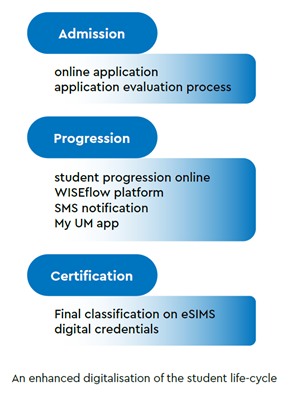
Significant investment has been carried out in the admissions process, which has resulted in an improved overall efficiency. The University offers the online application facility to all of its potential students irrespective of the programme level that they are going to apply for. The forms have been designed according to the target population and the relevant sections are displayed according to the below factors:
The Liberal Arts & Sciences and Visiting applications include the possibility for applicants to choose and pay for the respective study-units.
The post-application process has seen a major change when the new online method was launched. This process was implemented through a collective team effort between the Admissions & Records Office and the Online Application team within the SIMS Office. Whereas the manual vetting of the applications used to take weeks to be carried out, the new process is able to handle such work much more expediently.
Another advancement in this digitalisation process was the creation of the online task for Students’ Progression. Before the new online process was launched, rogression of students used to be carried out by printing student lists and sending them to the respective FICS. The process involved a lot of toing and froing between the central administration and FICS, apart from the waste of paper in order to print the lists. Through a new digitalised task, FICS users can send their progression decisions about every undergraduate student collectively according to each decision, thus being able to tick a number of students at one go. This option was vital in order to make the process less time consuming.
Online examinations through the WISEflow platform were another technological achievement for the University of Malta. WISEflow is a digital assessment platform that allows the creation of multiple-choice, short-answer, true/false, and other interactive exams, and can also be used for essay-based exams. Academic staff are encouraged to use WISEflow in order to benefit from its advantages, including the upload of examination papers and the marking of examinations online. This enabled the University to also actualise its vision to reduce the use of printed paper as part of its strategic aims on sustainability as outlined in the Strategic Plan apart from increasing the efficiency of the marking process.
WISEflow’s versatility allows FICS to organise the same range of examinations, as per previous assessments, and to actually improve on them, through:
Currently the University is undergoing an infrastructural project with the aim of using the WISEflow platform on a wider scale, where online exams will still be held on WISEflow, with the difference that these will be held physically on campus in our computer labs.
Another technological initiative was the SMS notification facility through which students are given real-time updates. Important information is being sent to our students through the use of a digital task which enables all FICS academic and administrative staff to contact students regarding urgent matters such as when a lecture is postponed.
The University is committed to keep in line with new technologies in order to stay relevant. In the past years, the University kept abreast with recent tools and invested in publishing essential information on students’ mobile devices through the My UM app, which is available for download from the Apple and Google app stores. The app provides information, resources and services available at the University of Malta, which in turn increases client engagement. This method of communication was another means of information distribution channel. As a student at UM, this app provides support at all stages through:
The University of Malta has launched a digital student card on My UM app for all enrolled University Students. This will be providing a better service to both students and staff.
UM students can now make use of services offered both on and off campus by presenting a digital identification as University of Malta students. Furthermore, all UM students may use this service abroad, even on an Erasmus+ mobility. The My UM student card can be used in instances where students need to verify their enrolment status to obtain any discounts offered by museums, public transportation and any other services.
The UM Staff card is also available via the My UM app.
For further information, please click here.
In previous years, the final classification of all the students used to be published in alphabetical order and fixed on the noticeboards of the Administration Building and the respective FICS. Technological aid helped the University to maintain a much higher level of privacy through the option that was given to the students to find their final classification on their eSIMS portal. When the GDPR legislation was published, the University was already in line with the requirements of the privacy of our graduands.
In collaboration with the SEA-EU and Europass, the Office of the Registrar embarked on a new project to provide European Digital Credentials for Learning to all of the University of Malta graduands from 2021 onwards. The European Digital Credentials for Learning include a digital version of the scroll that is signed with a unique electronic seal (that is the digital equivalent of an institution’s rubber stamp). This allows potential employers, education and training institutions to easily authenticate, validate and recognise credentials of any size, shape or form.