
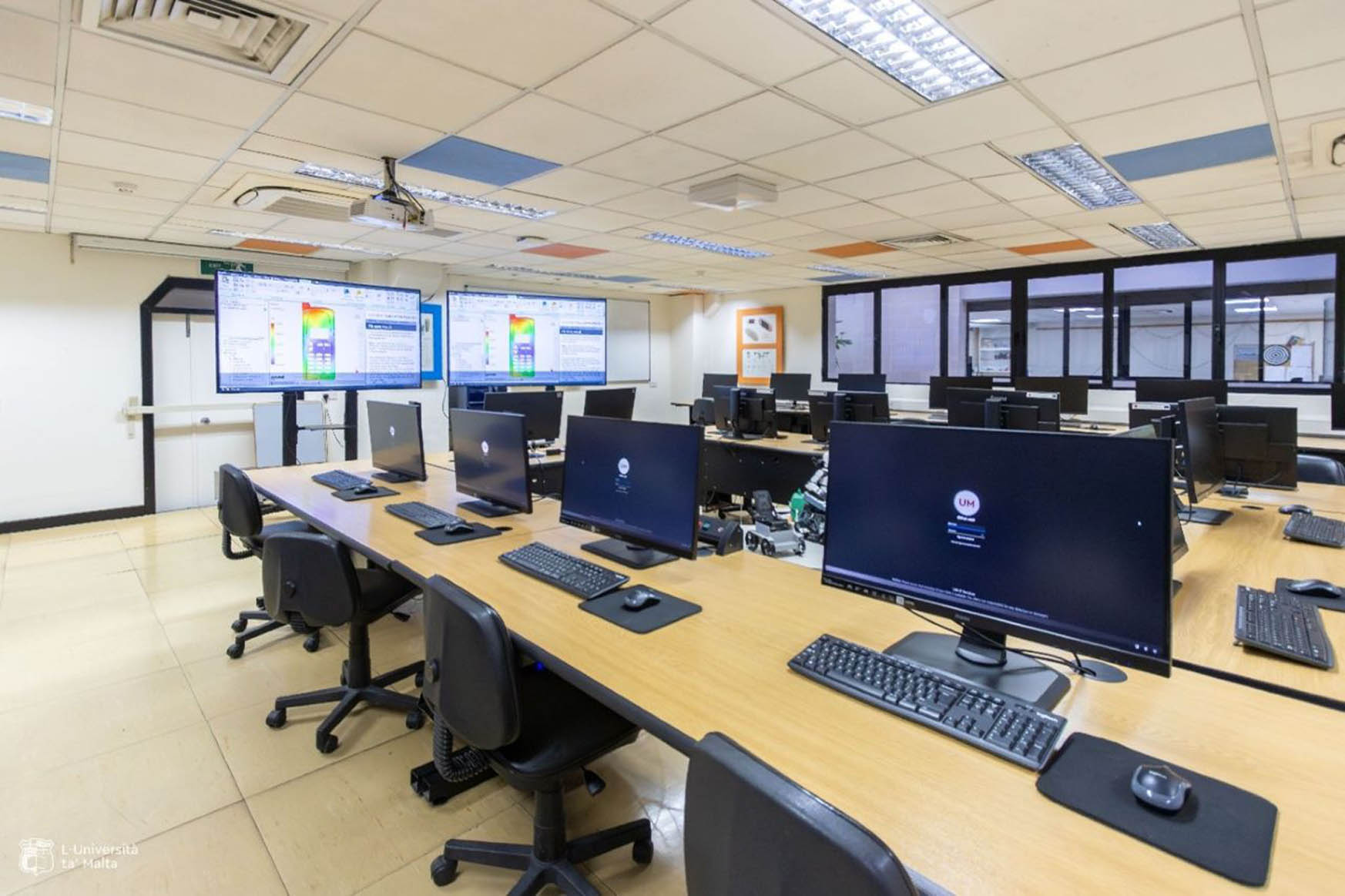
CAD/CAM technologies have nowadays become an integral part of product development. This is especially true given the increasing competition in industry and the diminishing time-to-market of a product. In the CAD/CAM Systems lab at the DIME, knowledge transfer activities are carried out to equip undergraduate and postgraduate students with skills required to design, simulate and build physical prototypes of product and factory designs. In the CAD/CAM lab manufacturing engineering students are given practical and hands-on instruction of simulation tools for injection moulding processes, factory layout and human ergonomics.
Research activities are also conducted at the CAD/CAM Systems lab. These include customisation of CAD packages, development of Knowledge Intensive CAD support, proof-of concept computer-aided sketching tools, and intelligent computer-based tools supporting factory design and simulation. The CAD/CAM systems lab is also frequently used to carry part-time short evening courses, in various areas of product development such as 2D and 3D CAD modelling and Rapid Prototyping.

The Advanced Manufacturing Lab at the DIME is equipped with
Our Polymer Engineering Research and Innovation Lab is equipped with an up to date equipment for conventional polymer processing and advanced polymer-based additive manufacturing (3D printing) as well as for polymer characterisation and testing.
This lab is used to provide our under and postgraduate students with comprehensive knowledge and experience in advanced manufacturing technology and also to offer services to local industry.
A number of student and industrial projects have been conducted such as rapid manufacturing of product prototypes, architectural models, wind turbine blades, medical implants and injection moulding tools.

The Conventional Machine Tools Laboratory is equipped with machines used for turning, drilling, milling, and grinding. This laboratory is primarily aimed at introducing undergraduate students to common processes used in industry for the manufacturing of parts by removal of workpiece material in a controlled manner. The emphasis throughout the laboratory sessions is on understanding the basic features and practical aspects of the processes. It also provides the students with knowledge on the respective machine construction, basic tooling and common machining practices.
Furthermore, the machines are also used to fabricate components for under - and postgraduate student projects

The DIME houses a Metrology Lab which is essential for education and research efforts as well as for industrial services in precision engineering. The metrology lab is well equipped with a wide variety of traditional dimensional measurement instruments such as vernier caliper and internal/external micrometer as well as optical measurement instruments such as autocollimator and engineering microscope, and supported with different type of gauges such as slip, plug and dial gauges. In addition, it also includes advanced measurement instruments, for instance computer controlled coordinate measuring machine (CMM), surface tester, gear and roundness tester and laser interferometer.

DIME labs also include a Computer Numerically Controlled (CNC) lab. This lab is used to hold lab sessions on this subject and also to machine parts required for students’ projects and from other requestors at university. In this lab, copper electrodes required for the die sinking machine are also machined. The lab facilities include two vertical milling machines: Bridgeport Series 1 Interact with a Heidenhain TNC 145 controller (2.5 axis) and a Cincinnati Arrow 500 vertical machining centre with Siemens Acramatic 2100 controller (3 axis). There is also a high speed attachment that can provide a spindle speed of 25000 rpm. Such speeds are required to provide optimum cutting conditions when using small cutters.
The aim of this lab is to carry out research and knowledge transfer related to the design and realization of reconfigurable manufacturing and automation systems.
Specifically, this lab will phase in systems able to manufacture different product variants, by instantly changing between parts and processes. This will comprise the following elements, but not necessarily limited to:
Material handling systems, industrial robotic systems, pick and place systems, industrial mechatronic systems, reconfigurable and flexible process control, PLCs and microcontrollers, Automated storage and retrieval systems, AGVs, AIDC systems, vision systems, inspection systems, reconfigurable machine tools, universal jigs and fixtures , conveyors, pallet systems, etc.
Polymer and Composites Laboratory
Sustainable Manufacturing Laboratory
Micro and Nano Manufacturing

The Immersive Learning Research Team, based within the Department of Industrial and Manufacturing Engineering at the University of Malta, conducts research into the use of immersive and emerging technologies to enhance engineering education and professional training.
The team explores how technologies such as Virtual Reality (VR), Augmented Reality (AR), Mixed Reality (MR), and other interactive digital environments can make engineering education more accessible, engaging and effective. Its research focuses on developing learning experiences that allow students and professionals to interact with engineering concepts, processes and environments in ways that bridge the gap between theoretical knowledge and practical application.
Over the years, the team has successfully secured and delivered a range of nationally and European-funded research projects. These include IMRTEL – I4.0/5.0 MR Training: Investigating MR Tools to Enhance Learning Experiences, which investigated the application of mixed reality within engineering and industrial training; MIT-QALO – Manufacturing Immersive Training for Quality Assurance and Layout Optimisation, supported by Xjenza Malta; and SKY-GUARD, which focuses on the application of immersive training technologies within the aviation sector.
The team is also involved in TRAINEE – Advanced MR Training for Human-Centric Production: Empowering Engineering Talent, a European collaborative project focused on advancing mixed-reality training approaches for human-centric manufacturing and the development of future engineering talent.
Supporting these activities is a growing technological infrastructure equipped with state-of-the-art immersive hardware and software. The team has access to the latest generations of immersive headsets, development platforms and specialist equipment, extending to advanced systems such as immersive reality treadmills. These capabilities enable the development, testing and evaluation of immersive learning environments across a broad range of engineering applications.
Through the combination of engineering expertise, educational research and advanced immersive technologies, the Immersive Learning Research Team aims to contribute to the development of more effective, accessible and industry-relevant approaches to engineering education and training.
