Image generated by Google Gemini
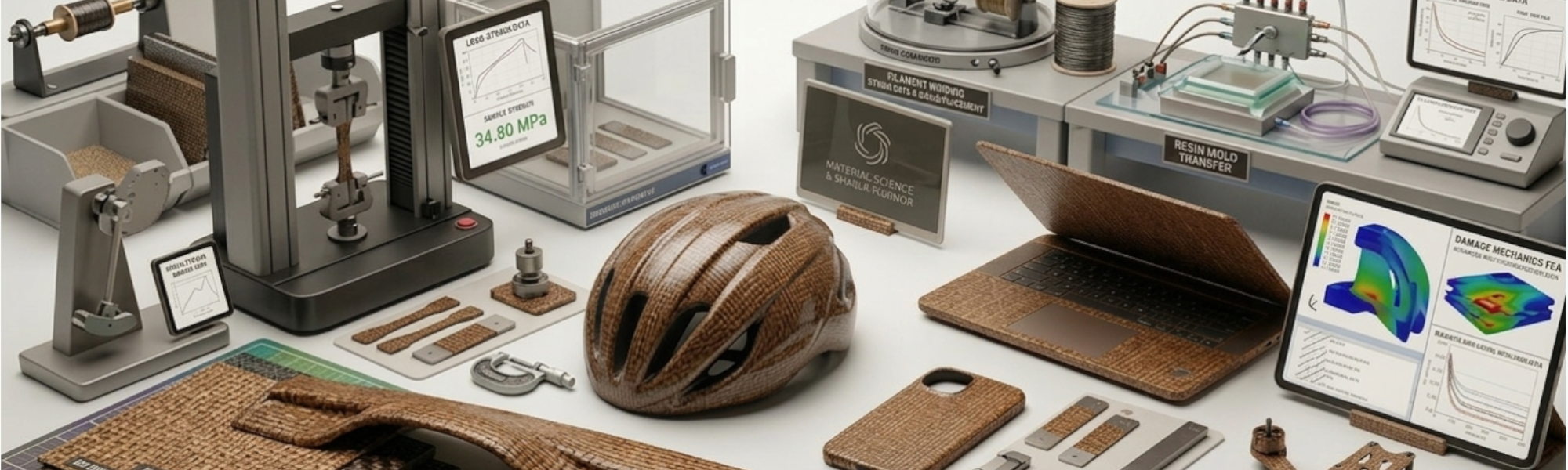
The Advanced Composites research hub bridges the gap between the development of advanced materials and structural reality by combining computational modelling with rigorous physical testing. From sustainable bio-resins and natural fibres to automated manufacturing, the team engineers next-generation composite solutions optimized for weight, strength, and sustainability through the following:
Composite Material Innovation and Application
- Bio-Composites: Developing sustainable natural fibre reinforced composites (flax, sisal, hemp, bamboo) paired with eco-resins.
- Hybrid Architectures: Engineering high-synergy interply, intraply, and micro-level intrayarn fibre blends.
- Sandwich Panels: Designing ultra-lightweight honeycomb and foam-core panels.
Characterization and Testing
- Material Evaluation: Standardized (ASTM/ISO) testing for tensile, compression, shear, flexure, and low/high-velocity impact strength.
- Resin Analysis: Rheological and thermal characterization (glass transition, viscosity, and degree of cure) to eliminate manufacturing defects.
- Experimental Testing: Setting and conducting realistic test environment loading characteristics of composite structures and components
Numerical Modelling Simulation and Optimisation
- Damage Mechanics & FEA: Predicting first ply failure and progressive failure analysis (PFA), delamination, and matrix cracking to minimize physical testing cycles.
- Structural Optimization: Algorithm-driven ply layup, orientation, and topology optimization to maximize weight-to-stiffness ratios for safety-critical components.
- Modal Analysis: Identification of vibration induced frequency response
Development of Advanced Composite Fabrication Solution
- Filament Winding: Automating continuous fiber placement for high-efficiency composite poles, pressure vessels and hydrogen storage tanks.
- Liquid Composite Molding: Utilizing Vacuum Bagging (VARTM) and high-precision Resin Transfer Molding (RTM) for low-void, high-volume production.
The team seamlessly integrates multi-scale virtual modelling with rigorous laboratory characterization to manufacture the next generation of lightweight, sustainable, and optimized composite structures.