
The MaltaHIP-II project is being carried out at the University of Malta by the Department of Metallurgy and Materials Engineering and Department of Mechanical Engineering of the Faculty of Engineering and the Department of Anatomy of the Faculty of Medicine and Surgery. Two partners support MaltaHIP-II: Mater Dei Hospital and EMPAV Engineering Ltd. The project is funded by the Transdisciplinary Research and Knowledge Exchange Complex (TRAKE), which is co-financed by the European Union through the European Regional Development Fund 2014-2020.

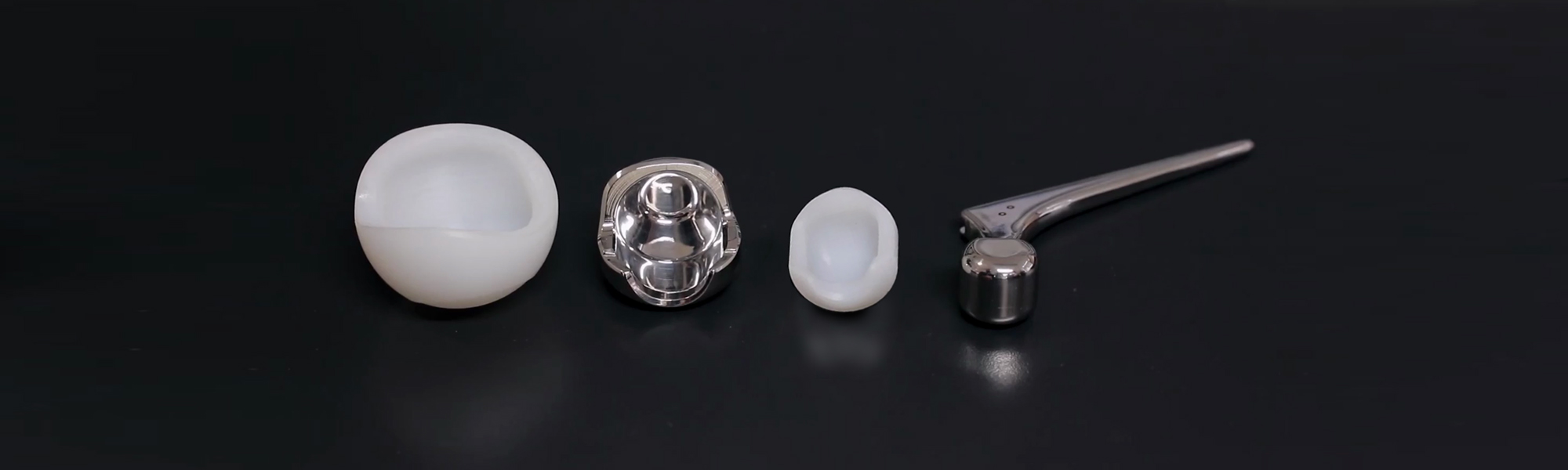
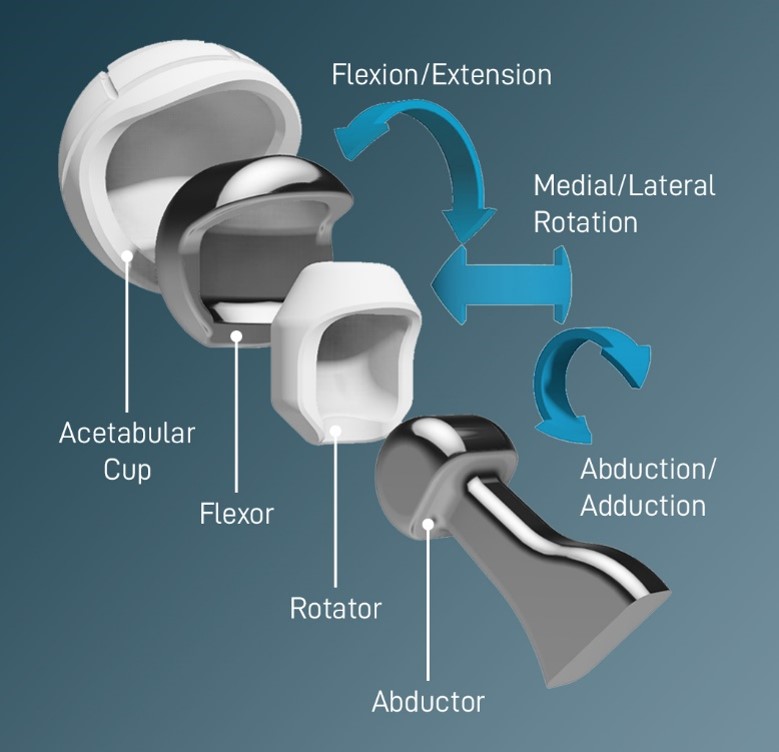
Prosthetic hip joint failure is frequently related to polymeric wear debris generated by contact stresses at the prosthesis articulation. Most hip prostheses consist of a multidirectional articulation between a metallic head against a polymeric acetabular cup. The MaltaHIP prosthesis presents a novel design that potentially offers superior wear resistance and a longer lifespan than currently available products. It consists of three cylindrical (unidirectional) articulations, each responsible for the movements on one of the three orthogonal anatomical axes: flexion/extension, abduction/adduction, and internal/external rotation. That is possible by the union of four components (acetabular cup, flexor, rotator, and abductor) assembled as shown in the figure below. The advantage of the novel MaltaHip design lies in two key aspects. First, articulations with a cylindrical geometry offer larger contact areas that reduce contact stress levels. Second, the polyethylene components present orientation hardening mechanisms that make their mechanical properties more resistant to unidirectional stresses.
The MaltaHIP was created as a medium-size prosthesis with an acetabular cup diameter of 53 mm. Hip joint simulator results of a prosthesis in this size showed excellent stability of its components and minimal levels of wear, confirming the advantages of the novel design. The MaltaHIP-II project aims to enhance the commercial viability of the MaltaHIP prosthesis by expanding the size range in which it can be offered. While the production of a bigger prosthesis does not pose any technical difficulty, a reduction in the size of its components implies a higher risk of failing. Our challenge is to reduce the acetabular cup diameter to 46 mm, the smallest size in the standard range, keeping the mechanical stresses in all components at safe levels. The MaltaHIP-II project requires multidisciplinary knowledge in medical sciences and engineering. Therefore, we count on a team of experts in biomaterials, tribology, fracture mechanics, anatomy, machining, and simulation.
| Name | Position |
| University of Malta Team |
|
| Prof. Ing. Joseph Buhagiar | Project Leader |
| Prof. Pierre Schembri Wismayer | Main Inventor |
| Prof. Ing. Pierluigi Mollicone | Inventor |
| Prof. Ing. Bertram Mallia | Collaborator |
| Dr Ing. Donald Dalli | Inventor |
| Dr Leonardo Fanton |
Research Support Officer IV |
| Mater Dei Hospital |
|
| Mr Ray Gatt | Medical Collaborator |
| Mr Ryan Giordmaina |
Medical Collaborator |
| Empav Engineering Ltd. |
|
| Manuel Pavia | Industrial Collaborator |